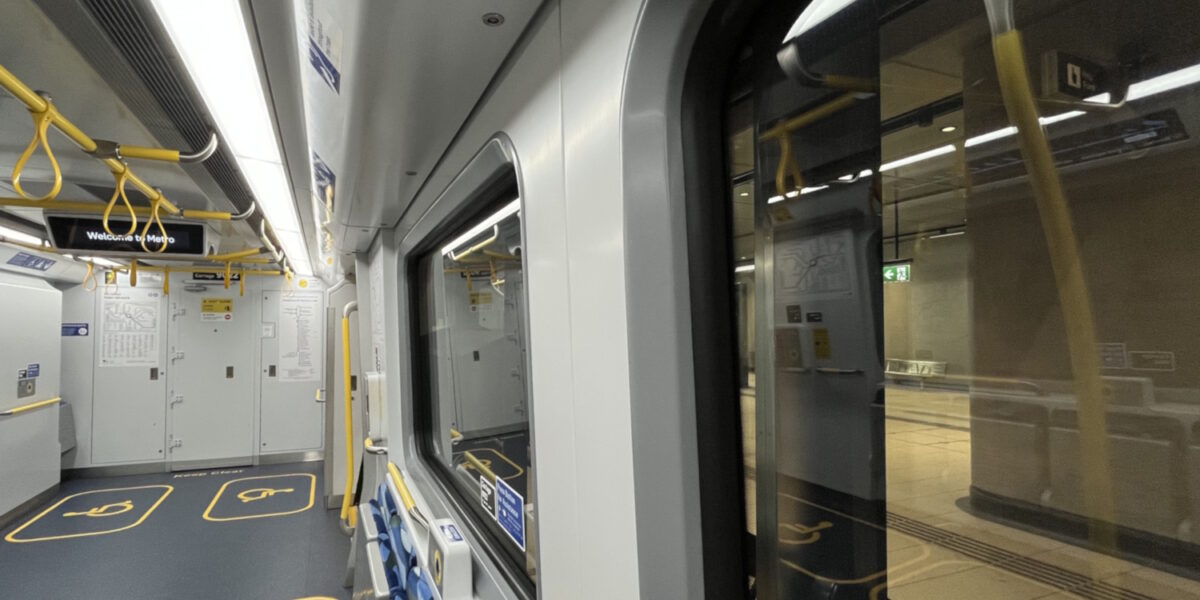
While we wait for the Metro Tunnel timetables to be released ahead of the full opening on 1st February, let’s talk about signage in the stations.
A criticism raised to me, and I think it’s right, is that there’s a lack of platform signage at the new underground stations: to be precise, signs to tell you where you have arrived.
In the 1970s, the City Loop underground stations were designed to be distinct colours.
In the 2010s, the rebuilt stations near me, Bentleigh McKinnon and Ormond, were all built with the same colour scheme. The latter two are partly underground, below the road, which makes them difficult to tell apart.

All five of the new Metro Tunnel stations also look quite similar at platform level.
There’s some nice orange features, but otherwise a lot of it is grey.

Indicators inside the train can help you navigate, but sometimes don’t work or are inaccurate. You need plenty of signs on the platform, visible from every window and door.
At Bentleigh, Ormond and McKinnon there are up to 10 signs per 160 metre long platform, meaning an average of one every 16 metres. It’s seems to be similar at many other stations.
Some platforms have fewer – there’s a big gap between signs on platform 3 at Bentleigh for instance, but if you can’t see a sign on your platform, you may be able to see one on a different platform.
From a quick check at State Library, there are 11 signs per platform. But the platforms are longer at about 220 metres, so this is an average of one every 20 metres.
20 metres might not seem hugely higher than 16 metres, but the Platform Screen Doors make some of the signs harder to see from the train, especially when arriving. And you can’t see signs on the other platform, because they’re facing away.
State Library also has some very long gaps between signs, for instance:

The issues with this were underscored to me on a trip through last week when the on-train information had broken down. The driver apologised and made manual announcements, but the sound quality wasn’t great.
So you may not be able to understand the announcements, and you may not be able to see any station name on the platform adjacent to where you are in the train.
You can compare Melbourne vs London in this footage I filmed on Elizabeth line in October.
(The eagle-eyed among you will notice the two London clips are out of order.)
I didn’t think to pack a measuring tape with me, nor to count all the signs, but it definitely looks like the Elizabeth Line has more of them.
Ensuring people know the station name is important, especially at underground stations, and especially at what will be some of the busiest stations on the network.
They should fix the on-board displays and announcements too, but simply putting more signs up should be an easy fix.
- While I was preparing this post I notice “TaitSet” has put out a video which also points out this issue. Well worth a watch.
- As I write this, V/Line is suspending services in much of Victoria on Friday due to a fire danger rating of Catastrophic. Best of luck to everyone in the affected areas. Stay safe.

14 replies on “Where am I?”
No issues seeing which station you are arriving at on the Sydney Underground.
https://www.reddit.com/r/SydneyTrains/comments/1mkijn4/i_am_obsessed_with_these_signs_on_the_eastern/
In fact one of the things Sydney Metro does is have the station name on all of the platform screen doors facing the train.
When I was in the Netherlands for training, 25 plus years ago, the train I was on stopped between stations and everyone started exiting. My Dutch was negligible at the time and I stayed until a nice lady explained we need to get on the bus to get to the station.
Not fun but a second announcement in English would have helped.
Malcolm, that signage in Sydney is fabulous! And it almost seems like it was designed with passengers in mind…
“but the sound quality wasn’t great”
Most announcements on Melbourne trains are incomprehensible. The sound quality was better in the 1980s. Why can’t they fix this?
Agree that these new stations need more signage telling you where you are, and/or a distinctive colour scheme like the city loop stations have.
Another type of signage which is lacking at the new stations is disability access signage.
I have mobility, vision, and hearing impairments. I walk with a stick. I can manage escalators if they’re not crowded and I won’t be forced on to them before I’m ready to step on, or jostled by someone pushing past me once I’m on. But I need to hang on for dear life, especially when descending.
I prefer lifts. They’re much safer. And of course, people on wheels can’t use escalators at all. They have no choice but to use lifts.
Escalators are large and prominent and usually easy to spot from a distance. But lifts are not. They’re often tucked away, flush with a wall or around a corner.
I’ve now made several trips through the Metro Tunnel, entering and exiting at Parkville, State Library, and Town Hall and looking around them to see how disability-friendly they are.
At each one of the three stations I’ve visited, there are not enough signs saying where the lifts are. I have spent quite a bit of time wondering whether I’m walking in the right direction and will find a lift at the end of it, and sometimes having to double back because I’ve guessed wrongly. Walking this extra distance is not easy when you’re disabled.
This is especially the case if you arrive at the station via train, but even if you enter from the street, the lift location is not always obvious.
Typical example: I entered Parkville Station from the street a couple of days after it opened. I went through the Myki barriers, then stood there and looked around. A staff member approached and asked if she could help. (Because it was brand new, there was a very visible staff presence.)
I said “I’m looking for the lift, or a sign telling me where it is. No, don’t tell me. You might not always be standing here. Stations should have enough signage for the travelling public to navigate by themselves, whether there’s a staff member available or not.”
So I stood there for a while and looked around. I saw no lift, and no signs indicating where I might find a lift. I finally said “I give up. Where is it?”, and she pointed down the far end of the concourse, further than I could see.
One lift, at one end of a long concourse, and poorly signposted, is fairly inadequate from a disability point of view.
But at least Parkville does have one huge advantage. It has a Travellers Aid presence (like Southern Cross and Flinders Street). I even encountered one of their volunteers pushing an empty wheelchair through the Parkville concourse, and she stopped and asked me if I needed help.
If you are disabled, and attending an appointment or visiting someone in the hospital precinct (RWH, RMH, Peter Mac) via Parkville Station, I highly recommend you phone Travellers Aid a day or two before. They can give you whatever assistance you require, including meeting your train on the platform with a wheelchair and taking you all the way to the hospital.
@roger, yes, the sound quality on trains (and trams) is often dreadful. Sometimes the only thing I can make out is “Thank you for travelling with Metro Trains / Yarra Trams” at the very end of the announcement.
I had high hopes that this project, costing more than any other in the world, would be world-class and easily comparable with the Elizabeth Line. Sadly, the people in charge in Victoria seem to miss every opportunity for great design. They can fix a lot of this by adding signs on every column, and they can make things actually intuitive and simple to understand, instead of using insider jargon (such as PSD, PID etc).
They can also get rid of ambiguous messages which require you to infer what they mean, such as ‘board trains this way’. In that example, a simple ‘door not in use’, with barriers or tape across long sections of screen door assembly, would be far more effective at telling people who’ve just got off an escalator that they need to do a U-turn and walk for 50 m to get on a train.
Another irritation I discovered is that all trains seem to begin and end at Town Hall. So while the train might be a Sunbury service at the platform, the screens inside the train show the journey ending at Town Hall. Then when departing Town Hall, they suddenly (or eventually) show the rest of the trip. This seems to be an operationally based behaviour similar to treating Flinders St as the terminal for every train, and it is useless to travellers. All they want to know is where they are going. They don’t need to know how the insiders visualise the operation of the route.
What makes the case of Bentleigh McKinnon and Ormond even worse they used a mix of yellow, orange, and red panels at the three stations – if they used used the panels of a single colour at a single station, you’d be able to tell the three stations apart instantly!
McKinnon is my home station and this has long been a bugbear. They could have used the PTV bus / train / team colours – orange for Ormond, blue as McKinnon Secondary colours, and green for Bentleigh Greens soccer club.
Bentleigh at ground level is easy to tell from McKinnon and Ormond, it’s the only one with a customer service window and myki barriers.
Oh, and occasionally a “SmartBus” out the front.
https://ptua.org.au/posts/2011/potd-not-a-smartbus/
Despite that link dating all the way back to 2011, it still rings true for the most part. Since then however, the 703 has had two changes: a basic (40-60 minute) Sunday timetable added throughout its entire length instead of only north of Monash Uni, and has been added to the Night Network roster, which inexplicably starts at 1AM instead of actually extending the timetable from the last regular service like every single other Night Bus, leaving a gap of 86 minutes (IIRC) between the last normal Friday evening service and the first Night Bus service, while still finishing at or before 9PM on public holidays that aren’t Friday nights. So, still very much not a SmartBus!
Back to signage though, it would be nice if the next train signs were flipped on their sides and the departure times enlarged. The small text combined with the change to black text on white is also hopeless in direct sunlight, although the latter was probably done to preserve the LCD panels rather than to make it readable (unlike CRT and OLED displays which don’t like displaying bright images for long periods, LCDs are the opposite and struggle with dark images and can get stuck pixels along with the LCD version of screen burn).
Couldn’t they just put some stickers on the train side of the platform screens? (I get that they don’t want to completely obscure vision into the train, for people looking for friends or for emergency services.)
@roger: I doubt this is anything to do with the hardware, because the automated station announcements are clear, and are surely using the same amplifiers and speakers.
Driver announcements vary, but are usually pretty clear. Almost without exception the “Metro Control Centre” ones are unintelligible. This suggests to me it’s staff training: a handful of employees holding the mic too close and/or shouting into it.
And trivial Metro Control Centre announcements should not cut into the automated platform announcements.
I too am perplexed at the poor sound of the announcements transmitted to the trains or stations (i.e. the ones not made on the spot by drivers or station staff). It seems that the audio system has been bandwidth-limited to telephone standard instead of being full-range audio. I noticed in London that the trains played perfectly clearly reproduced audio messages. In Melbourne, they sound like answering machine messages. This would have been easy to do better. It’s not as though the amount of data to be transmitted would be unreasonable. A full-range audio message 30 seconds long could be sent to a train or station with trivially more resources than it takes to transmit the dreadful audio files currently used.
[…] More staff and wayfinding signage has been deployed for the tunnel opening… though it’s not perfect […]
One thing that would help is illuminating the signs on the non-platform side. As they are I didn’t even realise they were there until i went looking to confirm if they were or not.