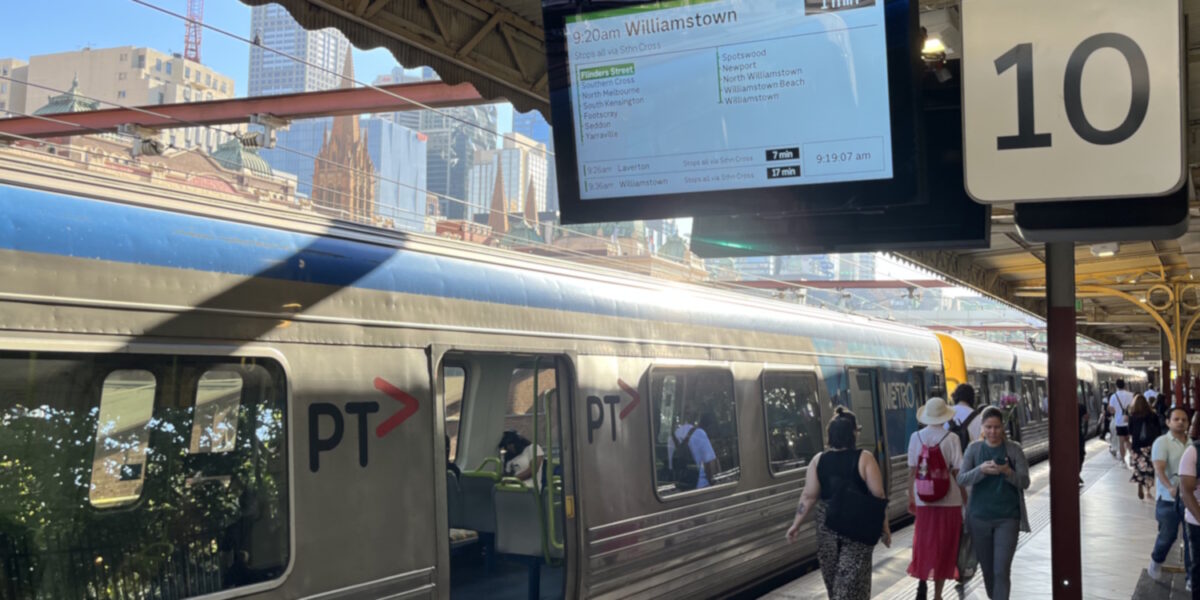
I’ll have another post soon on the Metro Tunnel, from the Big Switch day, but I wanted to get this one finished first.
I was keeping an eye on how public transport was affected by the extreme heat last Tuesday 27th January.
The temperature in Melbourne reached a high of 42.7 degrees, but it went even higher in other parts of the state.
In the past, there have been huge impacts from hot weather, but in the past decade or so there have been big improvements made to the infrastructure. Here’s how it went on this day.
Trams
In advance, Yarra Trams said:
Route 35 City Circle trams will not run.
Routes 1, 6, 19 trams will run at a reduced frequency during peak times.
City Circle W class trams don’t have air-conditioning, and potentially could be a risk of passenger or driver health issues in extreme heat.
The other change might be to reduce the power consumption of lots of trams running their air-con at maximum during the peak. Power issues are one reason a lot of substations have been built in recent years around the network, and why the new G class trams have batteries to improve energy efficiency.
Watching through the day, apart from a car colliding with a route 109 tram and a light rail level crossing (not related to the heat, one would assume), the only other notable service impact was during the afternoon.
Tram 72 got replaced by buses, not the first time that’s happened on a hot day. Perhaps they have power issues, or perhaps they wanted to reduce the exposure of passengers and staff to non-air-conditioned trams.

V/Line
V/Line will pre-emptively cancel services in areas with a fire danger rating of Catastrophic.
And services were directly affected by fires a couple of weeks ago, with the Harcourt fire damaging one of the rail bridges, which needed to be repaired.
On Tuesday they enacted Extreme Heat timetables, where trains run at slower speeds.
Tuesday, 27 January: Full Extreme Heat timetable on the Geelong (39 degrees), Warrnambool (39 degrees) Ballarat, Ararat, Maryborough, Seymour, Shepparton, Bendigo, Echuca, Traralgon, Bairnsdale lines.
Due to the forecast high temperatures in the region, coaches will replace trains between Bendigo and Swan Hill on Tuesday, 27 January.
Other disruptions on the day included
- Debris on track causing suspension between Bendigo and Gisborne
- Track fault near Lara during evening peak
They subsequently used Extreme Heat timetables on the Friday and Saturday, when it was cooler in Melbourne, but still hot in many parts of regional Victoria.
NSW Trainlink
Melbourne to Sydney (and vice versa) trains were cancelled south of Albury, replaced with coaches.
622 Melbourne to Sydney overnight XPT service is replaced by coaches between Melbourne and Albury due to the forecast of extreme heat. Passengers will join the XPT train at Albury to continue their journey.
It’s not crystal clear to me why this is the case given V/Line’s Albury service, which uses the same infrastructure, was still running, though at a slower speed.

Metro
Unlike V/Line, Metro doesn’t pre-publicise a slower timetable, but they do often put in temporary speed restrictions in hot weather.
During Tuesday, we saw:
- Approx 7:30am: Frankston line track fault – unclear if this was heat-related, as it occurred fairly early in the day
- Approx 2pm: Werribee line track fault, services suspended
- Approx 2:45pm: heat-related line speed restrictions on all lines except Stony Point
- Lift failures in the evening at Boronia and East Pakenham – no indication this was due to heat, but there were localised heat-related power failures which may have contributed.
So overall… most of the system kept running okay, with some delays, but nothing huge.
Thankfully the widespread issues we saw in the 2000s during heatwaves – train air con failures, buckled track and so on, don’t still occur to the same extent.
There was a Parliamentary Inquiry about this following failures in early 2009, and subsequently a lot of investment to help prevent this.
The system isn’t perfect on 40+ days, but it’s a lot better than it was.
Can it cope with more hotter days over time, as climate change takes hold? More investment will be required. Let’s hope they stay on top of it.

7 replies on “PT in the heat”
I’d guess that NSW Trainlink terminated short at Albury because they use a single train set from Sydney to Melbourne and back with a very short turnaround, and any late running through Victoria would put it’s roster out of whack for the next trip out of Sydney to elsewhere in NSW.
Lift failures at stations might be due to a failed air conditioning system in the lift shafts – architects love putting modern lifts into big glass boxes that get hot in the summer sun, so need active cooling to ensure they don’t turn into an oven, and if it can’t can’t keep the temperature cool enough, the control system locks the lift out of use so people don’t get cooked inside.
I don’t think it is a power issue for trams. More likely freeing up staff to have a break from the heat.
I didn’t know about the 72 bus replacement I guess it runs from Gardiner Station to the Camberwell terminus. Trams themselves operate fine in extreme heat, even if they lack air con or have inadequate passenger air con.
As far as I know, the only area I know that is short of power is Balaclava Road through to the East Malvern terminus, which sees the tram service alternate between B class trams and Z class trams.
Morocco runs high-speed trains through the Sahara at 320 km/h. Saudi Arabia runs their high-speed trains whether it’s zero or 50 degrees. China runs high-speed trains to Harbin, where temperatures range from -40 to +40.
In Australia, though, our rails apparently turn into wet noodles the moment the mercury hits 30. What’s wrong with our engineers?
The sandringham line is technically not affected by the speed restricted measures as their max speed is 75kph which is the metro heat speed limit on days over 40 degrees
@Marcus, great point about the XPT. From what Wikipedia says, they run a pretty tight schedule, sometimes with only an hour or two of recovery time before the next run.
https://en.wikipedia.org/wiki/New_South_Wales_XPT#Operating_cycle
@Andrew, the 72 buses ran from Anzac station to Camberwell terminus.
@Christo, the engineering solutions clearly exist. The politicians decide whether or not the money gets spent making them happen!
@Anonymous, thanks.
Yarra Trams said “Routes 1, 6, 19 trams will run at a reduced frequency during peak times.”
Those route numbers might sound fairly random to anyone who doesn’t ride them regularly, but residents of the inner north will know that they are the three routes operating out of Brunswick Tram Depot. Route 19 runs along Sydney Rd. Routes 1 and 6 both go up Lygon St as far as Moreland Rd, at which point Route 1 continues northwards to Bell St and Route 6 goes to the depot.
What this means is that every tram route east of Melville Rd and west of Nicholson St copped a reduced service, while (apparently) no other tram route did apart from the City Circle – and that’s more of a tourist thing than a commuter service.
Did Yarra Trams mention in advance that any other tram routes would have a reduced service?
If not, then does anyone know why Brunswick and Coburg commuters were chosen to bear the full brunt of this scheduled reduced service? Is there something special about the Brunswick tram depot which makes it unable to run a normal timetable on any of its routes during extremely hot weather?