Sunday! After breakfast in the hotel, we had a morning walk around the neighbourhood, ending up back at Hyde Park.
The Royal Parks Half Marathon was underway, with organisers cordoning off paths, getting ready for the energetic people to come through.
Though busy, the park was still enjoyable, and while overcast, it was looking like another fine day. My conclusion: autumn is a great time to travel to the UK and Europe.

Heading to Oxford
We ducked back via the hotel then walked to Paddington Station. I’d booked the hotel in this vicinity as I wondered how jet-lagged we’d be – it would make the planned trip to Oxford and back easier.
I’d pre-booked the tickets a month before, but on this route there was no saving for having done so. For the two of us, the off-peak day return cost £75.40 for a journey taking just less than an hour each way. An upgrade to First Class would cost more than double that. Ouch.
(At the time of writing, Australian dollars are worth about 0.49 UKP. But in these blog posts I’m going to try to resist converting amounts to AUD. I came to conclude that everything in Britain and Europe is just more expensive than in Australia – public transport, restaurants, groceries, everything – and wages too, I assume. An amount in EUR or UKP seemed reasonable if it was the same amount in AUD, but not if you converted it. I’ve come to the point of view that you have to remember that the most expensive part of the holiday is the airfares, and try not agonise too much about spending money while there.)
We boarded the train and found seats. Lucky we were a few minutes early, as the train quickly filled up. It ended up being packed all the way to Oxford.
The Train Manager made an announcement apologising, saying Great Western Railway had only provided 5 coaches instead if the scheduled 9. The verbal gymnastics referring to GWR as a separate entity was probably canny messaging on her part, putting her on this occasion at arms-length from her employer.
The GWR web page meanwhile claimed “a good service across our network”. If I’d paid 75 quid and got no seat, I would not agree.


The scenery whizzed by. Britain has little High Speed Rail (basically only the line from London to France, until they build HS2) but they’ve got plenty of lines reaching 200 kmh (125 mph), and this was one of them.
London to Oxford is served by trains every 30 minutes, with only two stops along the way (meaning other trains serve intermediate stations) at a pretty good speed that means it’s faster than driving. If all goes well, with every train turning up with a full consist, it seems like a pretty good level of service.
While packed to the gills, the train was more-or-less on time, and the vast majority of people alighted with us at Oxford. As we exited I had to admire the sheer scale of the bicycle parking next to the station.

Exploring Oxford
Oxford and its university have quite an interesting history. This episode of the Retrospectors podcast goes into one of the more interesting (and bloody) incidents, in 1355, and the background of the University.
We were in town to meet up with cousins and friends, and while waiting for the former, we explored for a bit.
Initially we headed due east from the station along Park End Road and New Road. I suspect “New” in a placename in Britain probably just means it’s less than 1000 years old – eg the New Forest, from 1079.
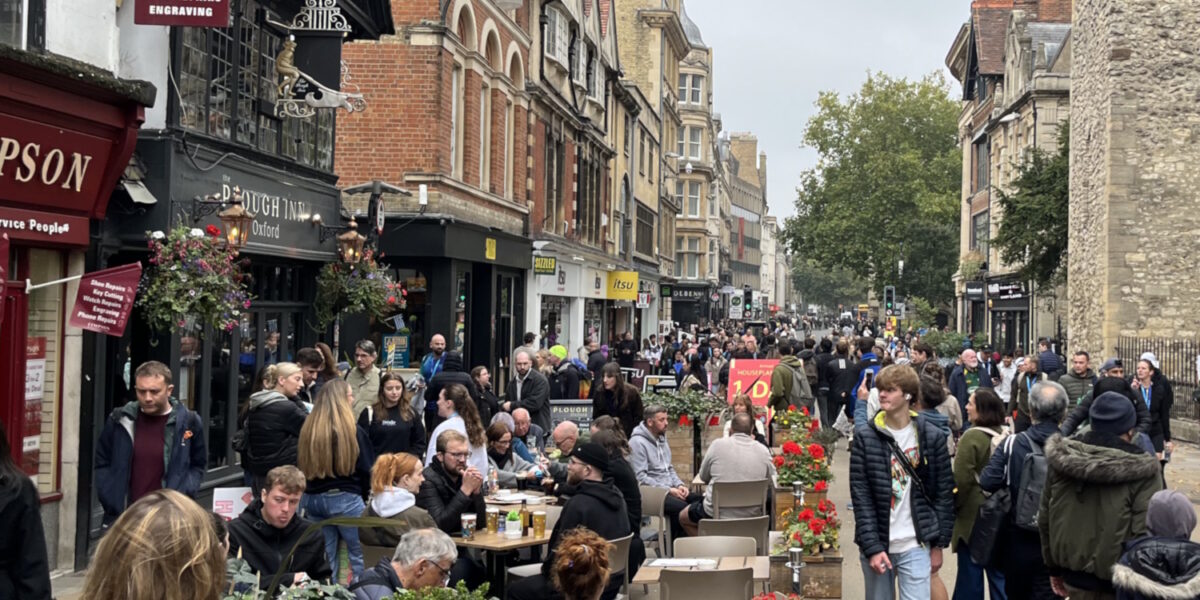
After failing to find many lunch places, we switched to the parallel George Street, which was better. Our cousins arrived, and we had a good chat as we walked around looking for somewhere to eat. Lots of places were too busy thanks to an earlier half marathon, but eventually we found a pasta restaurant to have lunch.
After lunch we continued chatting and walking, though the busy pedestrian precincts, and out along Broad Walk, past the rather splendid Meadow Building and the Christ Church Meadow.


Other sights we spotted included the stunning Radcliffe Camera, and the equally stunning Bodleian Library.


By the time our cousins had to depart, it was late afternoon, and our friends Ian and Louise arrived to say hello. We ended up doing more walking around with them – seeing some of the same buildings, but many different streets, accompanied by Ian’s encyclopedic knowledge.
Then we had dinner before parting ways.

The train ride back to London was far less eventful – busy but not packed. I noticed some long dwell times at a couple of stops, but it was on time and it wasn’t crowded, so no complaints from me.
And hooray, we’d survived another day without falling asleep.
Tomorrow: seeing more of London.

8 replies on “Exploring Oxford”
> At the time of writing, Australian dollars are worth about 0.49 UKP.
I’ve never seen term UKP used to refer to the Pound Sterling, The common term is GBP :)
> I came to conclude that everything in Britain and Europe is just more expensive than in Australia – public transport, restaurants, groceries, everything – and wages too, I assume.
A bold assumption to make there. Wages in the UK are most certainly lower than Australia on average. And even for high income earners in London the rents are so high that the disposable income is similar to people living outside London (where wages tend to be half as much). The UK is simply just more expensive for the average person and for transport in particular due to privatisation (and ageing infrastructure requiring expensive maintenance).
It used to amaze my British colleagues when I told them about QLD’s 50 cent fares and Victorias V-line myki price cap. The UK government simply doesn’t prioritise affordable intercity transport like Australia does (within cities there was £2 bus fare cap until recently).
> I’ve come to the point of view that you have to remember that the most expensive part of the holiday is the airfares, and try not agonise too much about spending money while there.
It’s a holiday, spend your money how you like!!! But these days I’d suggest with airline sales offering a ticket to Europe for around $1200 relatively frequently the majority of costs are actually city centre accomodation and resturants/activities rather than the flights themselves most of the time,
I’m sure you are aware of the man in seat61 website. The advice there is invaluable and advises to use the tfw (Transport for Wales) website when booking any UK train tickets. It’s never let me down and advance purchase with steep discounts are always available.
My then 95yo Dad visited Oxford University a few years a years ago and was invited to sit at the high table for a meal with academics. It was an appropriately stuffy affair. Right at the end a number of very small silver boxes with little spoons were presented to the table. It was a selection of snuff to partake in!
@Stirling, yes – train fares in the UK in particular seem very expensive. It didn’t seem quite as bad in mainland Europe (though I may aim to do some kind of comparison later)
@Andrew, Seat 61 will feature prominently in a post soon!
Interesting take on the relative cost of living in the UK and Australia. It’s probably right to, when you travel, spend a £GBP (or a euro or a $USD) like it’s an $AUD and worry about the credit card bill after you get home.
I think wages in London are comparable to those in Melbourne. I left Australia on about $94k at the TIO, and joined Ofgem (as a permanent staff member rather than a temp) on £50k. On the exchange rate at the time that was a slight pay cut, now it would be a slight pay increase. Looking at what I get at the FCA now, versus what I would get in a comparable position back home… OK, yeah, London wages are slightly higher, though tax rates are higher too (42p vs 38.5c for someone at my income level). Healthcare is cheaper here in the sense that it’s generally free, though in practice it can be hard to access. Not sure how much a restaurant meal is in Melbourne these days, but I get sticker shock every time I go back. I think a main in a midrange place was around $40, so £20, last time I was back there – so, comparable?
In terms of cost of living, housing is comparable, food is slightly cheaper here, utilities slightly more expensive (a kwhr of electricity is 25p or so in the UK, appears to be about 30c in Australia), petrol is more expensive here though not by as much as I thought (£1.30/L, $1.90/L there). A London bus journey is £1.75, compared to $5.50 in Melbourne.
Some years ago we caught the “Oxford Tube” bus to Oxford – see
https://www.oxfordtube.com/
There was a stop close to where we were staying so although the trip seems to take longer than the train, we made up for this by not having to get to Paddington. It was a “turn up and go” service, and seems a lot cheaper than the train (£24 return?). That said, given the number that you say were on your train, it seems that the cost of fares isn’t the only factor taken into account when people decide on their mode of transport.
Oxford looks like a fantastic city to wander around – no need for a car and close to London.
Thanks for the photos which really captured the history and beautiful buildings.
PS For the record, 500g of pasta at Tesco cost me 22p last month – bargain!
I suspect that you have posted a picture of the Sheldonian Theatre instead of the (visually very similar) Radcliffe Camera. https://en.wikipedia.org/wiki/Radcliffe_Camera
@Brian, thanks! I had accidentally posted the same picture twice. Fixed now.