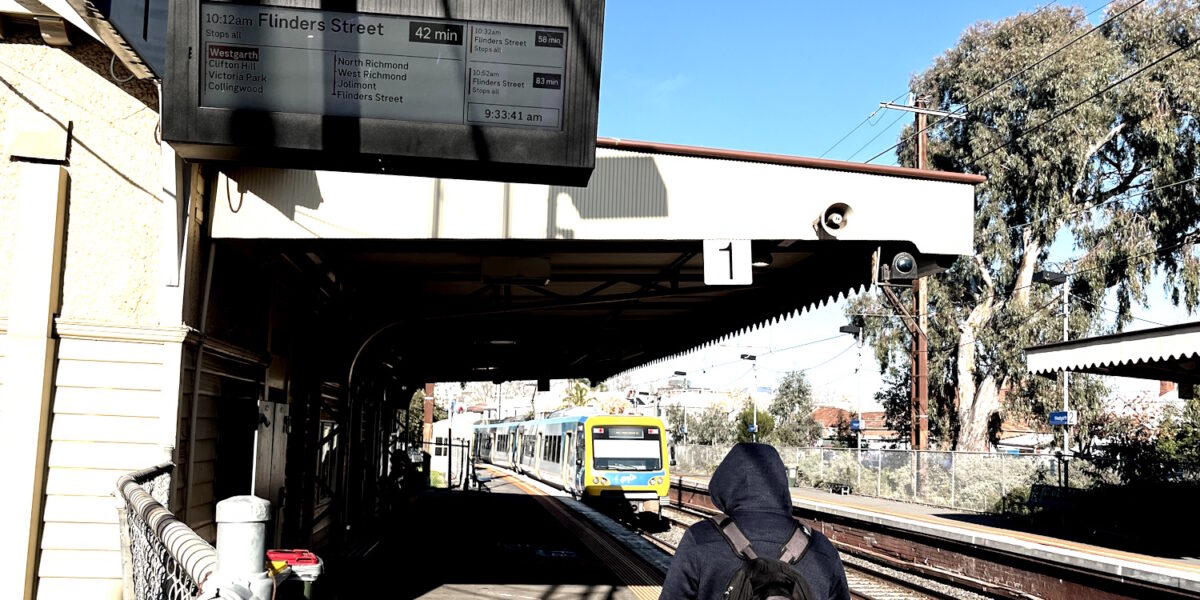
While looking through the old photos from July and August 2015, I found a snap of a page from a document I got off the back of a truck in July 2015: an internal Metro document called the Strategic Operations Plan 2013-2017.
There’s a lot in the document, but this particular page was of great interest because it summarised the planned timetable changes for that period – which included some really good train service improvements.
What happened instead is that in 2014 the government changed, and the Coalition pattern of funding mostly services but not so much for infrastructure was reversed. The government pivoted to the Andrews/Allan strategy of most money going into infrastructure, with little for additional services, despite continued population growth.
Here’s the page. Keep reading for a summary of where we could have been in 2017, vs where we actually are in 2025.
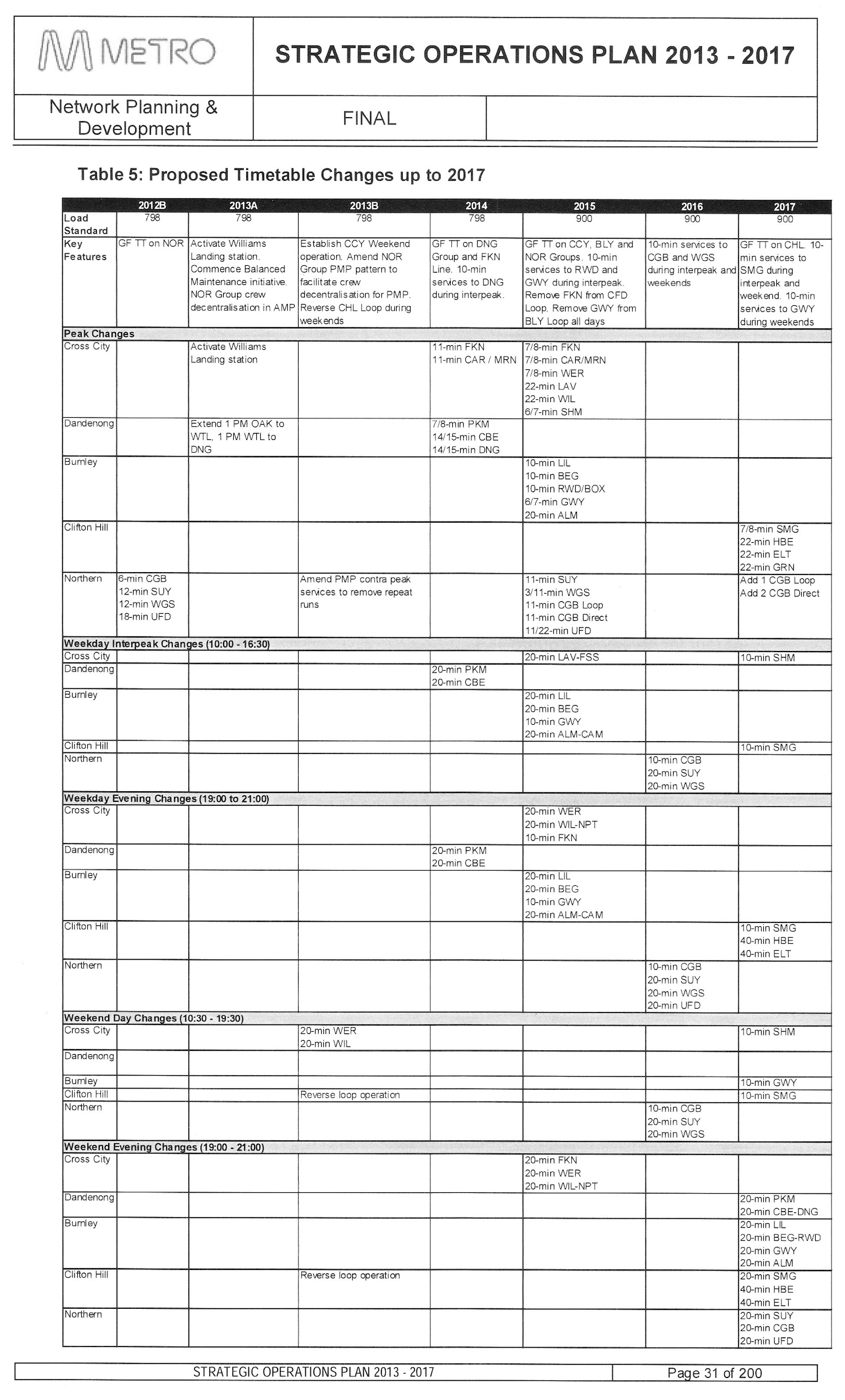
I was going to try and present a massive table comparing everything proposed vs now, but I think it’s easier to list the highlights of what the plan would have delivered. (Green tick if it happened, blue if it partly happened, red cross if it didn’t.)
10 minute frequencies during weekday interpeak and weekends between the City and:
- Newport✅ – since 2021
- Watergardens – not yet, but likely when Metro Tunnel opens
- Craigieburn❌
- South Morang❌
- Ringwood☑️- currently weekends only
- Dandenong✅ – since 2014
- Frankston✅ – since 2012
- Sandringham – weekday interpeak expected when Metro Tunnel opens
Greenfields timetable on Burnley lines, consolidating the myriad of stopping patterns❌
Upfield every 11/22 minutes in peak❌ – it doesn’t specifically say this would have been every second train only as far as Coburg or Gowrie, so it’s unclear how it would have worked.
Consistent Clifton Hill Loop direction✅ – done in 2013
20 minute frequencies to most stations in the evenings❌ – this has only reached the Sandringham, Frankston, Williamstown and Werribee lines so far.
From what we know, it looks like when the Metro tunnel opens, the Craigieburn, Upfield, Sunbury, Cranbourne, Pakenham will also get 20 minute evening frequencies (with a 10 minute frequency between West Footscray and Dandenong).
It’s a big welcome improvement, but will leave lines through Burnley and Clifton Hill mostly at 30 minutes.
No tunnel
So the 2013 document presented significant train service improvements. And the plans up to 2014 happened; but after that many were delayed, or didn’t happen.
All this was planned before dozens of level crossing removals and the Metro Tunnel were funded.
The source document mentions the tunnel would be important, but they were finding ways to improve frequency and make the train network more useful to more people, even without the tunnel.
We only got a fraction of the planned improvements. Much of it took until 2021 (eg Newport 10 minutes, 7 days). And some of it (Craigieburn and Upfield 20 mins evenings) we’ll only get once the Metro tunnel opens… and some of it there’s still no commitment for yet.
A Herald Sun story this week (Paywall) suggested that after opening the tunnel, a wider overhaul of timetables is on the cards:
This could potentially see Metro’s capability ramped up in three phases;
the first being to switch on for use, the second to increase peak period
services, and a third to overhaul the state’s public transport
timetables to fully maximise benefits across Melbourne.
Let’s hope that this is indeed the case, that it’s not too far off, and that it equals or exceeds what was proposed back in 2013.

8 replies on “What could have been”
Great article, once again.
While the record investment in infrastrure was desperately needed, the government would do well to better invest in improved service delivery, partucalrly with so much extra capacity coming online once the Metro Tunnel opens.
Sadly, one of the biggest losers remains both the Craigieburn and Upfield lines which still seem to have archaic service patterns for some densely populated inner suburban areas. I suspect without the remaining level crossings being removed on both lines, this will prevent further improvements in frequency.
Another potential “pre-Big Build” upgrade mentioned is a 22 min service from Hurstbridge in the peaks, well before the Rosanna, Montmorency and Diamond Creek duplications were funded
The May 2023 timetable has since achieved a 20 min service to Hurstbridge with much improved counter-peak services beyond Greensborough (plus the rebuilt station there) but the pinch-point is now between Clifton Hill & the City, with more trains forced to stop all stations
The need for Metro2 will only get more pressing as Wollert and beyond continue to be expand out, alongside the higher densities earmarked for suburbs such as Thornbury, Preston and even Epping
Excellent summary of where we could have been by now. The infrastructure spend was desperately needed and continues to be so. The ability to increase frequency even without some of that infrastructure is the most frustrating part of this government for me. I’ve contacted local MPs on train frequency and bus reform here in the northern suburbs but only get the standard replies we are spending big on infrastructure that will lead to better services. Yet here we are still running 20 min inter peak on the Mernda line 10 years later and no hints anything is about to change when the metro tunnel opens. If monies haven’t been allocated to fund drivers and service frequency by now, I don’t see anything happening when the tunnel opens until the next budget. Upfield won’t get anywhere until that is rebuilt for LX and loop connections and that’s been pushed away favouring the SRL instead, so money doesn’t exist. With an election due in 12 months, it’s time to bring the decade of construction pain into a proper service on trains along with buses from another mysterious plan that never shows up.
When it comes to projects, the inner east and inner southeast gets public transport projects, while here in the west, there is always a delay when it comes to public transport and we instead get toll roads. Remember that Labor abandoned East West Link (apparently opposed to toll roads), but later built a toll road in the western suburbs (and apparently took short cuts like no filters to minimise diesel flumes coming out of the West Gate “Tunnel”) because it is full of safe seats and people in the western suburbs don’t follow politics (the inner east and inner south east on the other hand are the most politically active, hence it is always more marginal).
Saying that, I do support SRL (and we all know that there had been cost blowouts with North East Link and West Gate “Tunnel” and not so much with SRL), but I feel that they need to invest more in the western suburbs (like build the western section at the same time as the eastern section, which could actually save money in the long-term). But also, there need to be investment in buses as well (many routes are on a frequency of 40-60 minutes, which is unacceptable in the 21st Century). I fear that this ignoring of the needs of Melbourne’s western suburbs could lead to extremists (both on the extreme left, as well as the extreme right) getting into power off the back of the anger that Melbourne’s west has towards the two major political parties which had ignored Melbourne’s west for too long.
We need to stop focusing on the inner east and inner south east and start investing in Melbourne’s west, which is one of the fastest growing regions in Australia.
I agree with indigohex3 and the comments about the west (and north) still short shifted on projects that are either delayed or just vanish. I see Melton line works have been accelerated along with some road projects in the Werribee area to be ready by the 2026 election, but electrification to Melton is still not included yet nor to Whyndam Vale which was mooted in the Western rail plan of long ago. Upfield line extension hasn’t been heard about and the Brunswick LX removals probably won’t start until after the election so may be dropped altogether as funds are diverted to SRL and NE link costs. Who knows really id the west and north will ever get more funding but politics is playing a much bigger part as the areas are becoming marginal.
@Tommo, the recent Werribee by-election saw Labor almost lose the seat. I think Labor should heed the warnings from almost losing Werribee to start focusing on the western and northern suburbs. One of the best ideas is the electrification of the Melton and Wyndham Vale lines, as well as the building of the Airport Line. But we should acknowledge that buses is also important for the western suburbs, in which many routes are still 40-60 minute frequency and finishes at 9pm (which, as I said in my post, is unacceptable for the 21st Century). And just like the message that Werribee sent recently, neither Labor nor Liberal should take the western suburbs for granted.
It looks like several routes in the Craigieburn area will get more service starting in October (https://www.busnews.com.au/victoria-announces-641-extra-services-across-eight-routes-in-melbournes-north/). I believe that this is a good thing for the northern suburbs, especially as the Hume region of northern Melbourne is a fast-growing area. So while this is a good start, more needs to be done in this particular region, like a 24-hour Night Bus like other regions of Melbourne. And speaking of Night Bus, it should be 30 minutes instead of hourly, especially on nights such as New Years Eve, which is one of the biggest nights on the calendar.
More buses means less cars on the road, so the bus upgrades in the Craigieburn area is a good thing. But again, more needs to be done.
Night Bus and Night Train both need to be upgraded to every 30 minutes and extended to public holiday eves and major overnight events (most commonly the Australian Open) regardless of the calendar day.
Quieter Night Bus routes could remain hourly, especially if they already run hourly after dark, but for major routes like SmartBus they should be no worse than half-hourly just like trams, also matching Sydney’s buses. Speaking of which, the remaining SmartBus routes should all be given Night Bus services.
Something also needs to be done with the 703 which still has a massive gap between the last regular service and the first Night Bus services (particularly on Friday public holidays where the bus finishes between 8 and 9PM while the first Night Bus is at 1AM), something which was fixed on all other routes long ago by extending their normal services until midnight; naturally, the 703 was left out of the Night Network upgrade just like how it never received a proper SmartBus timetable.
The 57 tram should also be added to the Night Tram roster given its unique coverage with no other night services nearby. Coincide the upgrade with the G class trams as a selling point. Probably the 16 as well since it already runs later than the others even on weeknights, connects a bunch of train stations, as well as offering an alternative to the overcrowded 96 in St Kilda; the 67 on St Kilda Rd just isn’t cutting it. Route 11 also being a weird omission.