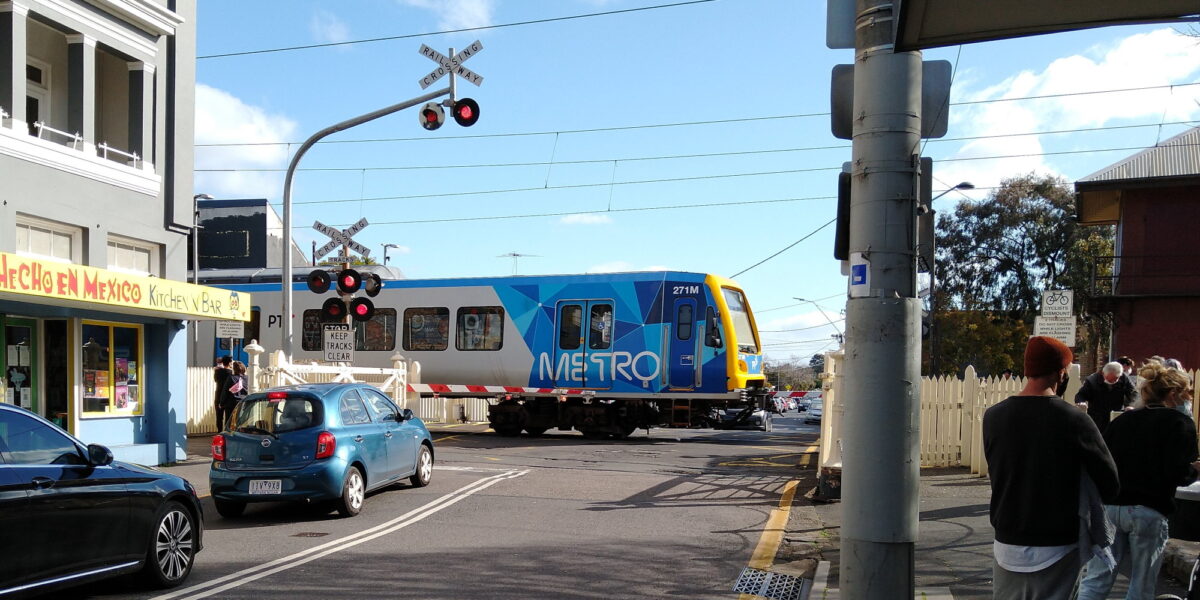
It’s Rail Safety Week. It’s a good reminder of what we can all do to stay safe around trains and trams.
I was wondering if Victoria’s massive Level Crossing Removal Program has improved safety.
(Warning, some of the content below is a bit grim)
The TrackSafe foundation has data on fatalities in Victoria, and breaks it down by separating out suspected suicides. If we exclude those (on the theory that crossing removals have their biggest effect on accidental incidents) then what can we see?
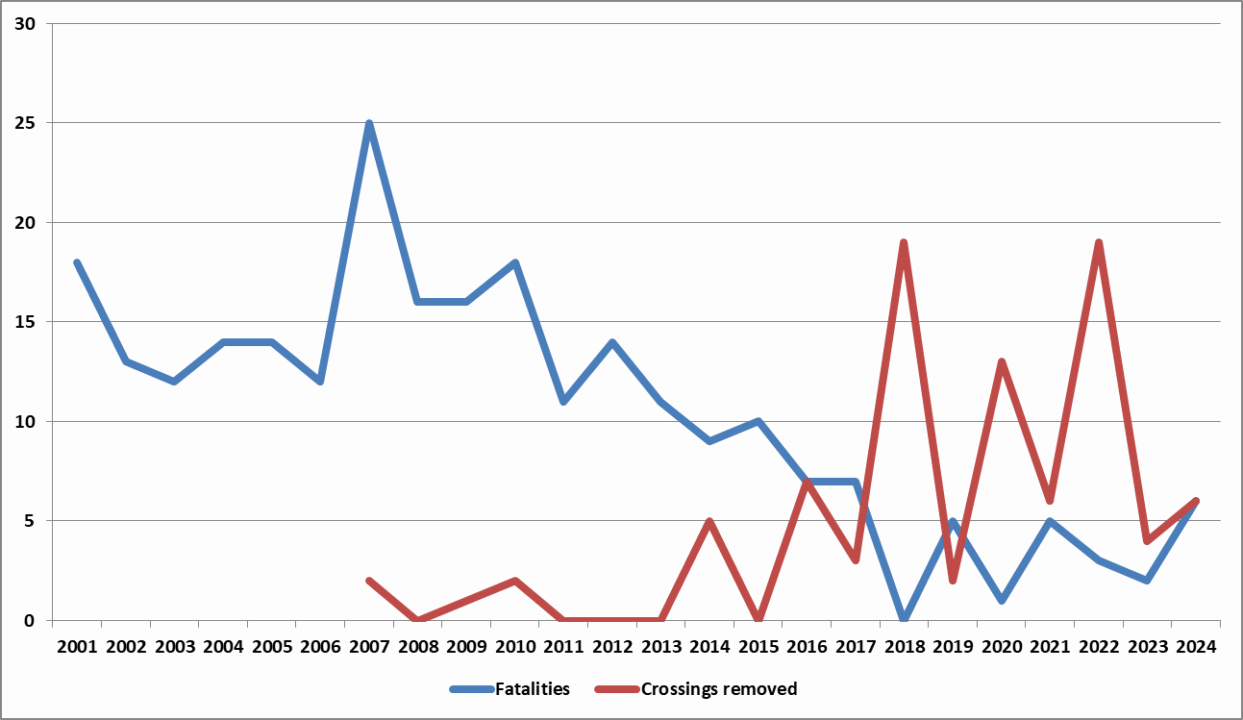
Important note: the yearly fatality data does not break down incidents on crossings vs elsewhere, so they’re not all at crossings. The crossing removals by year includes some done before the LXRP began, which included several of the worst.
So what can we see?
There was a peak in deaths in 2007, the year of the tragic Kerang disaster, when a truck collided with a train killing 11 people. Excluding that, average from 2001 to 2015 is 13.4 per year. Which is still awful.
From 2016 the LXRP got underway in earnest. The average from 2016-2024 drops pretty rapidly to 4 per year. Still bad, but it seems like a big improvement.
2020 may have been an outlier due to far reduced motor and pedestrian traffic, though most trains kept running. I’m not sure if there was something special about 2018.
That’s correlation, but is it causation? I don’t know, but it is striking.
The catch-cry for the LXRP is removing “dangerous and congested” level crossings. Hopefully the trend shown in the chart will continue.
- Lifeline 13 11 14
- Rail Safety Week
- Last time I tallied up the crossing removals was in 2022 – yeah probably due for an update
- If anybody has info about crossings removed between 2001-2006, leave a comment. (And yes, this is road crossings, not pedestrian rail crossings)

18 replies on “Have crossing removals improved safety?”
My recollection is that between the Kennett-era Boronia grade separation and the Laburnum grade separation in 2007 there were zero level crossing removals in Victoria. Level crossing removal simply wasn’t on the political radar at the time, as the PTUA often highlighted. That made Laburnum quite a big deal when that actually proceeded.
Cumulative crossings removed would be a better measure
In 2018 there were many crossing removals and maybe the works happening at so many sites with traffic heavily controlled led to less incidents.
No level crossing removals on the Sandringham line for probably a century. In fact, there has been at least one new crossing added over the past ten years.
Remember that Victoria wasn’t just grade separating level crossings in this period.
After Kerang, the government spent quite a bit of money improving rural level crossings: boom barriers at all highway crossings, many rural urban crossings, and *all* public crossings on lines with Vlocities; 80 km/h speed restrictions over highway crossings; rumble strips; pedestrian gates at rural urban crossings; and some crossing closures. I’d suspect a goodly percentage of the reductions prior to around 2015 is due to that work.
As Christian mentions, a more meaningful data line would be “number of (dangerous) crossings”, plotted beside annual accidents.
One would hope to see a direct correlation.
Interesting to note the fall in fatalities. Amazing effort to remove so many LXs and with excellent results. Many lessons for other jurisdictions.
“dangerous and congested”, oh don’t get me started. The removal of the Champion Road crossing is quite unnecessary and nobody wants it to happen except the obdurate LXRP people. No locally acceptable replacement (all the traffic that currently has 2 ways to cross will be pushed onto a single already-busy road), not a dangerous crossing, only briefly congested anyway, and the extra services that they claim would increase the congestion are very unlikely to happen. We campaigned, we got on breakfast TV, we lobbied local and federal ministers, but it all fell on deaf ears. Their catch-cry is, round here at least, just an excuse.
Rant over, sorry.
@Tony, thanks – yes the other one in 2007 was Taylors Road on the Sunbury line.
@Christian, I was thinking afterwards that another way of doing it would be to add up the ALCAM scores of remaining crossings as they were removed, because theoretically the most dangerous crossings removed would have a bigger impact on safety and the number of incidents. Ideally of course all the ALCAM data would be public.
@Roger, one that springs to mind is Elsternwick, in 1960. Not sure any since then on the Sandringham line.
@Andrew, great point. Even before Kerang, there’d been crossing upgrades as part of the Regional Fast Rail project.
Are the numbers for both pedestrian and road crossings?
If we could get a breakdown between those two groups that could act as a position to advocate for removing pedestrian crossings too, which has seemingly been a secondary consideration for the LXRA.
The report you highlighted does give a specific breakdown on Level Crossing related deaths.
Collision with Road Vehicle:
2016 – 3, 2017 – 1, 2021 – 1, 2023 – 2. Total 7
Collision with Pedestrian:
2019 – 2, 2020 – 1, 2022 – 1, 2024 – 1. Total 5.
This data is on Page 8 of the report. There is also matching expanded data on Pages 14 and 15 as well.
Beware that the report as Daniel points out can be very confronting and the data you see is right in your face. Read it at your own discretion.
https://tracksafefoundation.com.au/wp-content/uploads/2025/05/2001-2024-Fatalities-injuries-near-hits-VIC-April-2025.pdf
You removed the Kerang accident as anomalous, but it’s sheer luck that we’ve only had one such level crossing crash with passenger fatalities.
North Rd Ormond, where express trains barrelled through at 80km/h or more over a wide road with a lot of truck traffic, comes to mind. A collision with a truck there could easily have had a death toll in the hundreds. The seats on Metro trains would be less crashworthy than on “regional” services, and there are often more standees. I seem to recall the brakes failing on a Siemens there back before that problem was fixed.
At least if a car goes around or crashes through boom gates, injuries on the train are unlikely, except perhaps for the driver. All bets are off with a B-double or a loaded petrol tanker,, and it’s worse on crossings not near a stop or used by expresses. Probably most of the heavy truck routes have now been grade separated.
You can think of the cost of the grade separations we pay today as an insurance premium to avoid a disaster with a smallish likelihood, or you could project future disasters and amortise the cost over 150 years. Either way, I think it’s a real benefit not accoounted for in your analysis.
@Francis, I left Kerang in the chart, but point taken. The risk is real.
Including Kerang in the 2001-2015 average figure increases it from 13.4 to 14.2.
Many would remember that North Road was the site of a terrible crash between an express train and a police vehicle on its way to an emergency call. https://npm.org.au/honor-roll/christopher-cameron-malone/
Hi Daniel, could you please post an updated level crossing removal table (like this one from 2022: https://danielbowen.com/2022/11/05/level-crossings-nov-2022-update/). I like your table because its listed by the ALCAM risk score.
Cheers!
@Gautham, yep, definitely planning an update! Some good progress since 2022, and it’ll be interesting to see what gets added to the pledge list coming into the 2026 election.
It’s way safer now that they’ve removed the two level crossings on the Belgrave line. No more cars having to wait 30 seconds at the level crossing for the two trains per hour that cross in each direction at Bayswater!
Heihachi_73, I disagree about Bayswater. The crossings may not have been the busiest in Melbourne, but definitely more than four trains an hour. One of those crossings also had to operate for multiple train movements in/out of the adjacent maintenance facility.
Bayswater would have to be one of the best designed upgrades in terms of the traveller experience and walking/cycling provision.
Re 2026 pledge list. With the funding kitty bare and the SRL and Melb airport sucking up the infrastructure funds, I don’t think there will be anything added with regard to the LXRP. The planned Frankston and Upfield crossings will be the selling points for 2026. Service upgrades may finally be the election promise on all lines though but I would have thought starting that in January 2026 would have made more sense. Given there hasn’t been much announced on that or the funding for it, it’s not likely now until the election. Likewise with tram extensions and bus timetables- maybe they will be the 2026 election promises. I live in hope as always.