
Alan Kohler does some terrific finance reporting, helping making complex concepts simple.
But I think he missed the mark on this opinion piece on trams last week.
(It’s only a couple of minutes long, so you may want to watch if you haven’t already seen it, before reading on.)
He’s missed some of the history, which is vital to understanding where we are now.
Let’s go through some of what he said.
“When Melbourne was laying what is now the world’s biggest tram network 120 years ago, other cities around the world were digging subways.”
- Firstly, he seems to have used the term “subways” in the American sense; the rest of the world calls them metros. Possibly the reason for this is that he’s conflated high capacity metro/rapid transit systems with underground railways, as we’ll see below.
- Secondly, more importantly, those other cities didn’t weren’t just “digging subways” instead of building trams. Most of them did both.
- The older cities he quotes later in the piece all had extensive tram networks, but later got rid of them (in some cases only to start building new lines later): New York City 1832-1957, Paris 1855-1938, London 1860-1952.
- Most cities later got rid of their trams, and replaced them with buses. Melbourne is something of an outlier in keeping an extensive tram network, though not unique. And it wasn’t a foregone conclusion that trams would be kept – it was probably only due to timing of then-recent upgrades and the efforts of people like Robert Risson that they weren’t all replaced with buses.
“There are now 214 cities in the world with extensive underground railways.”
- The 214 seems to come from Wikipedia. Fair enough.
- But the definitions are wobbly. I’ve talked about this before: Metro vs suburban/commuter rail in particular is a grey area. As Wikipedia itself notes: The dividing line between the metro and other modes of public transport, such as light rail and commuter rail, is not always clear.
- And importantly (because Kohler’s piece later zeroes in on tunnelling costs), these are not purely (or even mostly) underground railways. 40% of NYC’s Subway runs aboveground; in London about 55% of the Underground is aboveground. Some systems on the list of 214 such as the new Honolulu “Skyline” are completely elevated.
A key lesson here is that cities usually don’t build their railways underground unless they have to. At or above ground level is cheaper, so they will do this if they can.
So in Australian cities, we ended up with railways mostly built at ground level because the cities were being established as the railways grew with them.
But in established central cities there’s usually no space for new ground level railways. That’s why New York, London, Paris all built underground railways in their city centres from the 1860s onwards. Outside city centres (particularly in London and New York) their “Subway” or “Underground” systems and other railways were mostly built aboveground.

In Australia we didn’t build underground rail until the 1920s Sydney City Circle, and in Melbourne the 1970s City Loop, and these are only small portions of much larger aboveground suburban networks.
Today, I would argue that the key difference between metro systems worldwide and Australia’s suburban rail networks isn’t the tunnels, it’s the “Turn Up And Go” service frequency. But, again, that’s the argument about definitions – whether suburban rail can be counted as metro. (And even systems that definitely are metros don’t have universally good service frequency.)
Construction costs
Kohler goes on to talk about rail tunnel construction costs, basically saying that they’ve gone up and up and up over the decades.
This is unsurprising. While technology has improved, labour costs have gone up, so too have safety regulations (more than ever it’s rightly frowned upon if lots of low paid workers digging your tunnels suffer from industrial accidents).
The requirements for all these systems have also changed a lot. London’s Underground older “tube” tunnels are famously constrained because of limitations of tunnelling back in the day. The newest Elizabeth Line is a complete contrast – it’s spacious by comparison.
Tunnelling has also got more complex because the cities they are building them in have grown, and these days there are huge numbers of underground services that need to be found and relocated before digging – plus, as Kohler notes, authorities aren’t as keen to use cheaper “cut and cover” tunnelling which is very disruptive at surface level.
Beyond that, the geological conditions also play a part in tunnelling costs, and can vary widely between cities.

He then compares “subways” to trams, saying Melbourne’s trams “don’t carry many people, average 11km per hour, and clog up the roads.”
- He’s quoted the Melbourne CBD average speed for trams. The network-wide average is 16km per hour, which definitely needs improvement, but it’s 45% higher than what he’s quoted.
- The slow speed is also a problem with Melbourne’s trams specifically, not trams in general. For instance the Gold Coast Light Rail average speed is similar to that of the Paris Metro.
- “Many people” is relative. Trams carry fewer than trains of course. But Melbourne’s 24 tram routes carry about 155 million passenger journeys per year, about 35% more than Melbourne’s hundreds of bus routes.
- The clogged roads argument is very old school thinking, the type of argument that sparked the Citizen Tram film in the 1960s.
- Put it this way: A moderately loaded tram with 100 people aboard taking up 35 metres of road, and 30 cars carrying 35 people (average car occupancy) taking up 150 metres of road, are all in a traffic jam together. So which mode is actually clogging up the road?
Kohler then decides to compare Las Vegas “Loop” tunnelling costs, and this is where the whole piece really goes off the rails.
“Musk says he can get the (tunnelling) cost down to $10 million per mile, which nobody believes. But even if he missed that by a factor of ten, it’s still a lot cheaper than the Suburban Rail Loop. So why don’t we hire them?”
- The Vegas Loop tunnels are only big enough to fit a (Tesla) car, with no space for so much as an emergency exit. So of course it’s much cheaper.
- The tunnels are so constrained you’d struggle to even get out of the car and evacuate if a problem occurred.
- And of course the total carrying capacity is tiny, even compared to trams, let alone metro/subway systems – even if they overcome the staffing costs (one driver per car, max 4 passengers).
- So it’s a completely invalid comparison. And while some of Kohler’s other reports have a healthy infusion of humour, there’s no hint of sarcasm here.

The right mode for the job
Ultimately, cities should pick the right mode for the job. Trains, buses, trams, ferries, cars, they all have their place. They fulfil different roles.
Trains and trams aren’t really comparable, other than both using rails. The capacity of a train is 5-10 times as high, and they’re generally faster, but they need more specialised (and separated) infrastructure to work well. But trams can run along streets (both a curse and a blessing) and effectively serve shorter trips, as stops can be closer together.
Cities that got rid of trams mostly replaced them with buses, which at the time were seen as the closest equivalent in capacity and speed, as well as also running on roads.
Maybe you can argue that cities with metros decided they didn’t need trams, and that helped get rid of them. But plenty of cities without metros also got rid of their trams, and some cities kept both. To argue that Melbourne’s trams are a failed choice against city metros doesn’t really stack up.
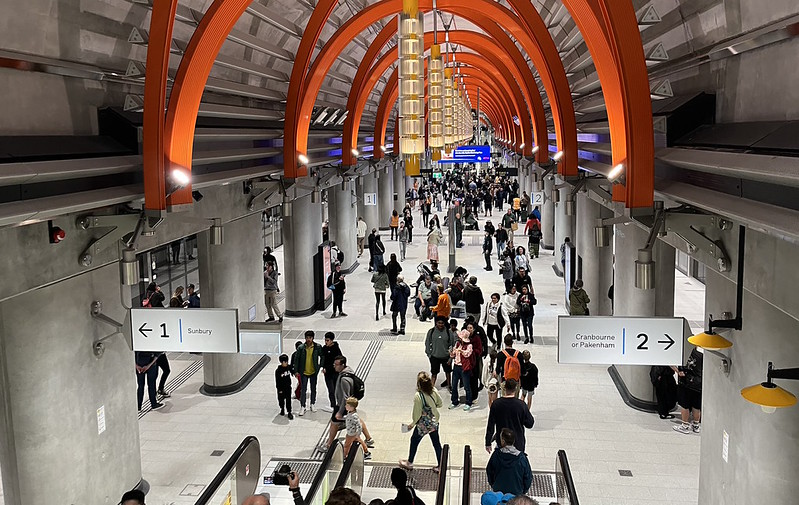
The good news is that Melbourne’s trams can be vastly improved, and some of this is already happening – the upgrade of small Z and A class trams to bigger the G class has commenced. Accessibility is lagging, and speed isn’t improving – but can be if the government pulls their finger out and takes traffic light optimisation and priority seriously.
And Melbourne may not have what Wikipedia counts as a metro, but it has a big rail system, with similar trains to world metros, similar stations to many metro systems, and far fewer level crossings than it used to have. It’s got huge potential.
To get all of the benefits of a metro, they just need to run more of the trains frequently, all day every day.
Notes
- The comments on Kohler’s YouTube video were originally open. Mostly they were not favourable to the piece. ABC News decided after a few hours to pause them, and now appears to have stopped/hidden/deleted them altogether. Comments are still open on the Instagram and Facebook posts.
- Kohler’s piece also sparked this news.com.au article, with comments from people who do know a lot about transport, Jago Dodson and Graham Currie.

7 replies on “Kohler on trams”
I was waiting for you to weigh in on this – normally Ive confidence in Alan’s pieces but maybe since this is an area I know something about (more than I know about economic markets anyway) I was pretty surprised about the glaring errors in the comparisons mentioned. I had to wonder if I was missing something.
Thank you for your response, with comments I hadn’t considered, and evidence!
“Most cities later got rid of their trams, and replaced them with buses. Melbourne is something of an outlier in keeping an extensive tram network”
Most cites? Is there a statistic on that? Hundreds and hundreds of cities around the world kept their tram systems. Melbourne is hardly an outlier.
@Tony P, maybe I should have said the Anglosphere rather than most cities. But I should research that a bit more. I wonder if most of the cities that kept them are in Europe, with relatively few elsewhere?
@Daniel Bowen Largest number is in Europe, but all around the world basically. Check “List of Town Tramway Systems” in Wikipedia. It will show both former and still operating systems around the world. Pretty accurate article in spite of being Wikipedia!
Kohler has a highly tuned instinct for stories and “takes” that maximise his reach… old newspaper editing skills that predate the concept of clickbait.
He’s also well versed in evaluating evidence, and I believe he knows the comparisons he’s making over time (19th vs 21st build standards) and concepts (loop vs metro) are fallacious.
So he’s getting a lot of attention, and I have a theory that the “Kohlerverse” functions as follows: appear on the ABC early in the week to maximise traditional older tv audience reach. Go to paid business and economics events later in the week mostly attended by older capitalists (often for a very high fee) to network and pick up fresh stories and their “vibe”. Pick a topic from those events to run on the ABC for eyeballs and clicks the following week. Rinse and repeat.
Remember he’s fabulously wealthy from selling his business media assets alone. So his current appearances, I suspect, are all about maximising reach and apparent relevance in the target markets that still care about what he says.
A shame when someone so respected like this talks down public transport.
As a person in finance some of his takes have been as poorly researched and reasoned like this as well.
I don’t think Kohler is talking down public transport, but merely stating the logical obvious. Trams are the least productive and least efficient transport method, compared to Buses and Trains. Yes, there’s a certain romance to keeping trams running, but no one should ever be confused about their impracticalities. If you think otherwise, your logic would also maintain that Hook Turns should be implemented at every intersection. As you were.