In our last exciting instalment, SNCF had cancelled one of our trains for today. I’d scoured the web, and worked out an alternative plan to get us from Lyon to Arles.
Originally it had been:
- depart Lyon 11:07 by high speed train to Nimes, arriving 12:24.
- then an hour in Nimes for lunch
- regional train 13:27 from Nimes to Arles, arriving 13:48.
This latter train was the one that was cancelled, and although it’s fairly a short journey, there didn’t seem to be a lot of other options. What I was learning was that France has a complex web of a train network, with most services being pretty fast, but some of them not particularly frequent.
The revised plan was a regional (TER; Transport express régional) train, slower but direct: departing Lyon 12:13, arriving in Arles 15:09. So for a distance of about 250km, it was just under 3 hours, rather than 2.5, but no need to change trains, and no hour long wait for a connection. Pretty good for a plan B.
The only niggle was this turned out to be slightly more expensive… TER train fares are not cheaper when pre-booking, but the high speed train on the original journey probably is, and had been booked two months in advance.
Given the amount of luggage, and the prospect of changing trains on the Metro, or a packed tram, we decided to get an Uber from our accommodation to Lyon Part-Dieu station.
It was probably slower than the Metro, with lots of traffic lights, and single lane one way streets. I’m not complaining. City centres should not be faster by car than Metro.
At the station we checked the Platform and Hall (concourse, aligning to different sections of platform) details, and found a waiting room, and bought some snacks – as we knew the train would not have catering.
I also bought a copy of Charlie Hebdo, the French satirical newspaper for my stepfather. He’s a fan despite not speaking any French, but the latest edition had articles about the Louvre robbery, so I figured he’d at least be able to look through it knowing what they were talking about.
The waiting room had a short story machine, which is a fun idea – shame it wasn’t working.


Departure time came up and we headed to the platform.
While our previous train trip had been on a modern TGV, this was a 1980s-era train. Old high floor carriages (which proved a little challenging with all the luggage) and what I later identified as a BB 22000 class locomotive (built between 1976 and 1986), a chunky design that rings bells for me from reading Lima model train catalogues in the 1980s.

The carriages had compartments, and we settled into an empty one. You can’t reserve seats on TER trains, and it did start to get busy, but nobody claimed the two unused seats in our compartment.
It might have been an old train, but we had no complaints about the cleanliness or comfort (though I note the toilet at the end of the carriage was a little basic).

And no complaints about the speed of the train. My GPS speed app reckoned we got up to 160 kmh, which is the same as the fastest regular operating speed of trains in Australia (Victoria’s VLocity fleet, NSW’s XPTs, and Queensland’s Tilt Train).
There were good views of the countryside as we rolled along. Sights included the Craus nuclear power plant, any number of vineyards, and the station at Orange (which was not orange).


There are a lot of low platforms at stations around France. I recall seeing in Belgium that they were gradually switching to higher platforms, but it seems the French are sticking with low ones, building their newer trains with low floor boarding.
We arrived in Arles right on time. It was a 20ish minute walk from the station to our apartment, with views of the river – the same river from Lyon, the Rhône.
There were some steps to negotiate, but the weather was fine, and stretching the legs was good.

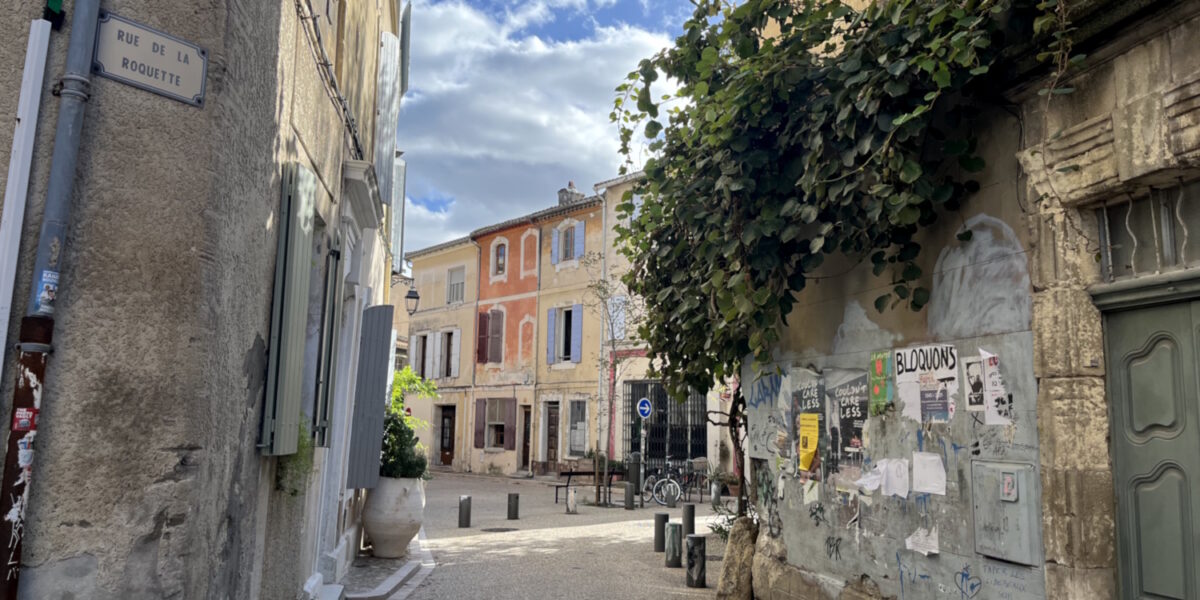
We ended up in the narrow streets of the old town. This was fascinating to me. Lots of closely packed medium density housing, typically 2-3 levels, with gardens hidden out the back, and very narrow cobblestone streets.
And no cars. That is, almost no cars. Occasionally you’d see one, but there was nowhere to park here, so they’d be strictly for drop off and pick up. I later learned there were car parks a few minutes walk away, outside this area.


It was like nothing I’ve seen in Australia.
We found our accommodation, a three storey house, met the manager for a briefing (including a description of how to close the front door when leaving) then unpacked and had a walk around. About five minutes walk away we found the local supermarket, boulangerie, pharmacy, and where the restaurants were. Local bus stops were also nearby.
So many people could easily live in this kind of area, without a car, but with access to essentials. (The whole town of Arles is not like this, as we would discover in coming days.)


A bit later we headed out to a restaurant that had been recommended for dinner. Very tasty.
Tomorrow it’d be time to explore more of the town.

One reply on “Heading south: Lyon to Arles”
You are not the only person to grab a meal in Arles. You join Vincent van Gogh who did some famous paintings of them. Not sure if these cafes survive to today.