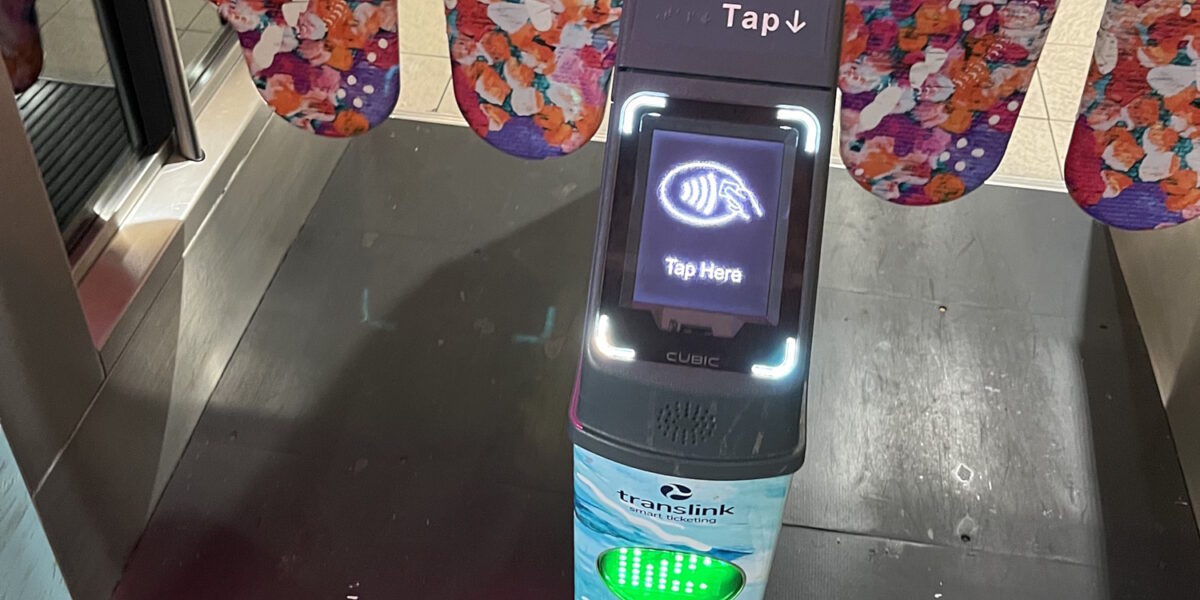
Since the recent trip to Brisbane, I was pondering the effects of the 50 cent public transport fares. They apply citywide to all services (except Brisbane’s AirTrain) – as well as regional Queensland city services – but not to long distance services.
Queensland puts out weekly stats, lagging by about three months, going all the way back to 2012:
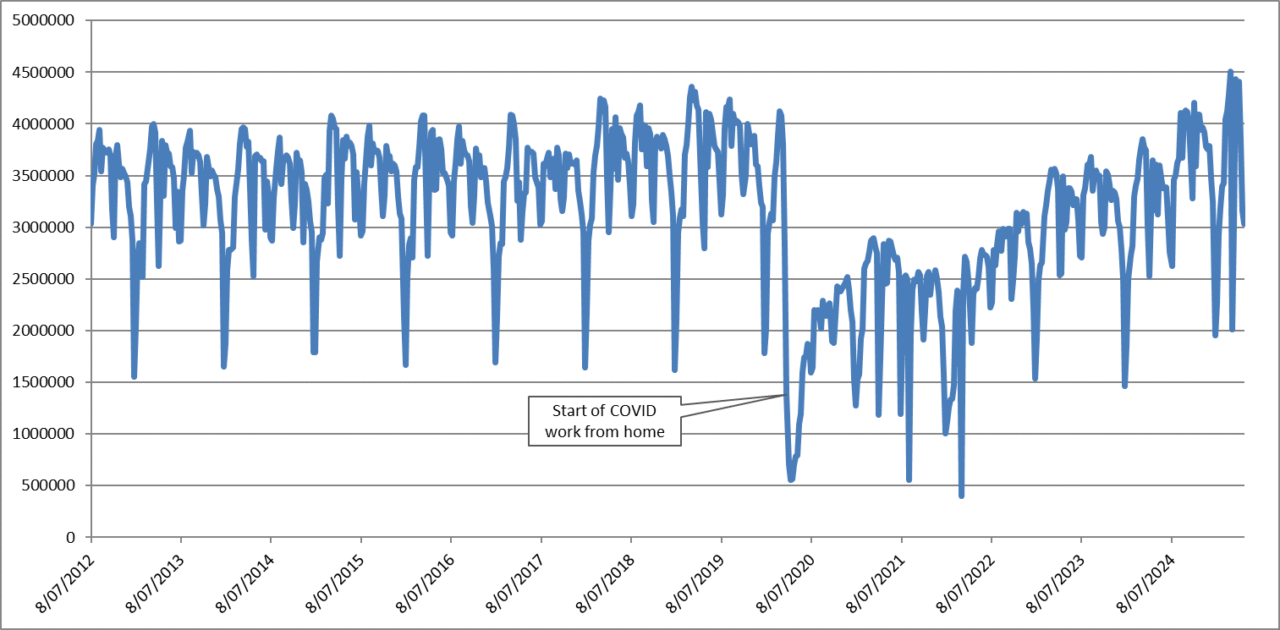
You can see a dip every Christmas period, and it’s up and down at other times of year, probably linked to school holidays and Easter.
Growth from 2012 to 2019 was not spectacular, you’d have to say. August 2012 had a peak of about 3.95 million per week; March 2019 about 4.36 million. That’s growth of 10.4%, or about 1.5% per year.
Over the same time, Brisbane’s population grew from about 2.095 million to 2.372 million; about 13.2%, or 1.9% per year. So you could argue that PT patronage was rising, but actually going backwards.
And – like elsewhere around the country, patronage fell off a cliff in 2020 when the pandemic hit.
Gradually after that it recovered – with some blips in 2021 and 2022, perhaps due to pandemic impacts and major flooding in February/March 2022.
Here’s the chart showing mid-2020 (after the fall) to April 2025 (the latest published data):
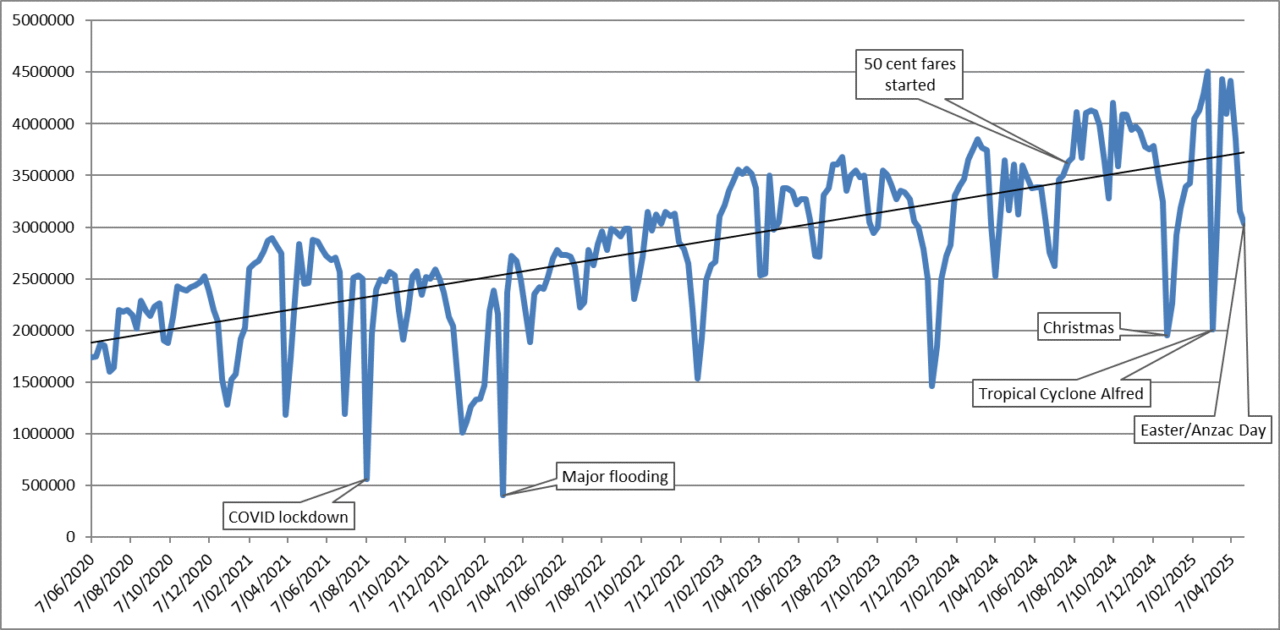
50 cent fares started on 5th August 2024 – initially planned to be temporary, but quickly made permanent. So what was the effect on patronage?
There’s definitely growth, but it it looks to be not too different from the trajectory that was happening anyway post-pandemic.
But notably, patronage reached 4.51 million in a week in March 2025. That’s higher than pre-COVID, which I suspect many other jurisdictions have not yet achieved, even with population growth.
It dropped the following week to just 2 million – this was due to the network shutdown of several days during tropical cyclone Alfred. The final dip in the data at the end of April is probably due to Easter and Anzac Day both occurring at the end of that month. One would assume the numbers recovered after that.

One of the key justifications claimed for the fare cut was to relieve traffic congestion (“Miles plan to bust congestion”), but I don’t know if there’s any data showing if that has been the case.
Will there be continued growth from the cheap fares? I suspect it’s the usual story – growth on the parts of the network with decent services that people can easily use, not so much where services are sparse.
As David Roberts notes, service is everything.
Brisbane is delivering on infrastructure and service upgrades too – the big bus revamp in June included additional “Metro” (bus) services and route changes that hopefully made the network more usable. And the Cross River Rail project, similar to Melbourne’s Metro Tunnel, is expected to open in 2029.
What about regional cities? The public data I can see only has annual numbers up to 2022/23 financial year, though there was some data published in February 2025 (presumably sourced from the Queensland government) showing increases.
The cost
Queensland budget papers say the cost of the fare cut is expected to be $1.522 billion over 5 years (eg an average of $304m per year), and then $368.8m per year after that.
How does that compare to total revenue? In 2024 it was $324.7m, so based on the forecast cost, revenue has been slashed by 93.7% (but the cost estimate may factor in expected patronage growth).
If fare revenue is now only about $20 million per year, does it even cover the cost of fare collection? The current ticketing system rollout was expected to cost $371m, but ended up at $434m – which appears to cover operations for 17 years from 2018… so $25.5m per year.
That equation of course only counts the ticketing system cost – and may change if patronage continues to grow strongly, and depending on the level of revenue from regional cities, which will also eventually be included in the Smart Ticketing system.

What next?
Thanks to the 2024 State Election campaign, both sides of politics said the discounts are permanent. Will patronage keep rising?
It’ll be interesting to watch how it goes in coming months and years, in Brisbane and elsewhere around Queensland.
Updates
Discussion of this on Reddit’s /r/brisbane
Elio Campitelli on Mastodon has done some extra work on crunching the numbers, comparing to population data. (I’ll try to embed the charts; it’s not working for me right now, but you can follow the link to see them.)

8 replies on “Brisbane PT patronage growth”
Does it also mean there is no longer a need to touch off? I remember they had a default fare that was higher than the highest section fares.
“Under section 218M of the Transport Operations (Passenger Transport) Regulation 2018, the department may charge a default fare (or fixed fare) to your card if you don’t tap on at the start of your trip, or tap off at the end of your trip.
Default fares are there to ensure a fair go for all passengers on our network so remember to always tap on, tap off.”
Currently, the default fare is $2.50 for bus, train and ferry and $24.80 for the Airtrain ($2.50 Child fare on Airtrain).
I thought it was a stupid idea, and it seems the figures prove it so. Those who argue for free public transport should take great note that cost is not even close to being the primary reason for not using public transport.
@Andrew C
It was for me, I used to ride my motorbike to work, I’ve since switched to train
Interesting timing! I happened to have just landed in Brisbane this morning (a few minutes before you posted this) and found out about this AirTrain fare the hard way.
Turns out, as long as you are leaving from, or going to the airport, the fare is $22.30 with the Go card or bank card regardless of distance. (There is an online booking that saves a few dollars, details below). The problem is that we (the four people including myself) only needed to transfer to a bus at Eagle Junction, which is two stops and only about 10 minutes away. With the combined ~$90 that we spent just on those two stops alone, we could have easily taken a taxi/Uber directly to the destination with some change to spare. I don’t see why anyone would use this section of the AirTrain (starting from the airport) when they could just jump on a taxi to the next stop (potentially even with a like-minded stranger to split the cost) especially since taking the train from the next stop instantly becomes a 50c fare.
*Side note about the online booking: there is a checkbox at the bottom of the form that says (Optional) Donate $1 to QIMR Berghofer Medical Research Institute for Brain Cancer Research (non-refundable). While it seems like a very worthwhile cause, I can’t help but notice that it is automatically preselected, and the user needs to opt out rather than opt in.
SEQ is a desert of service delivery once you get away from Brisbane’s busways, the BRT routes and sections where railway lines overlap.
If you live outside the Brisbane City Council area, your local bus route is most likely a 60 minute frequency service that stops running at 6pm, connecting with a 30 minute frequency train line.
The previous fares were very pricey as there were no daily or weekly caps, but if only if they could have went with a balanced approaching to reducing fares to a similar level as other cities whilst increasing services, rather than putting it all on reducing fares to almost nothing whilst services remain terrible.
@Andrew C
I feel like that’s mostly beside the point. While it’s true that this particular fare change was promoted as a way to reduce car usage, most of the time when people argue in favour of free PT, it’s in relation to cost of living more broadly. Public transport should be a public service like libraries or parks, not run like for-profit corporate entities.
The impact for some is huge.
I’ve had to make many trips to the Gold Coast since the 50c fares came in. That preserved multiple daily car rides.
An Uber is ~$300 BNE <→ GC.