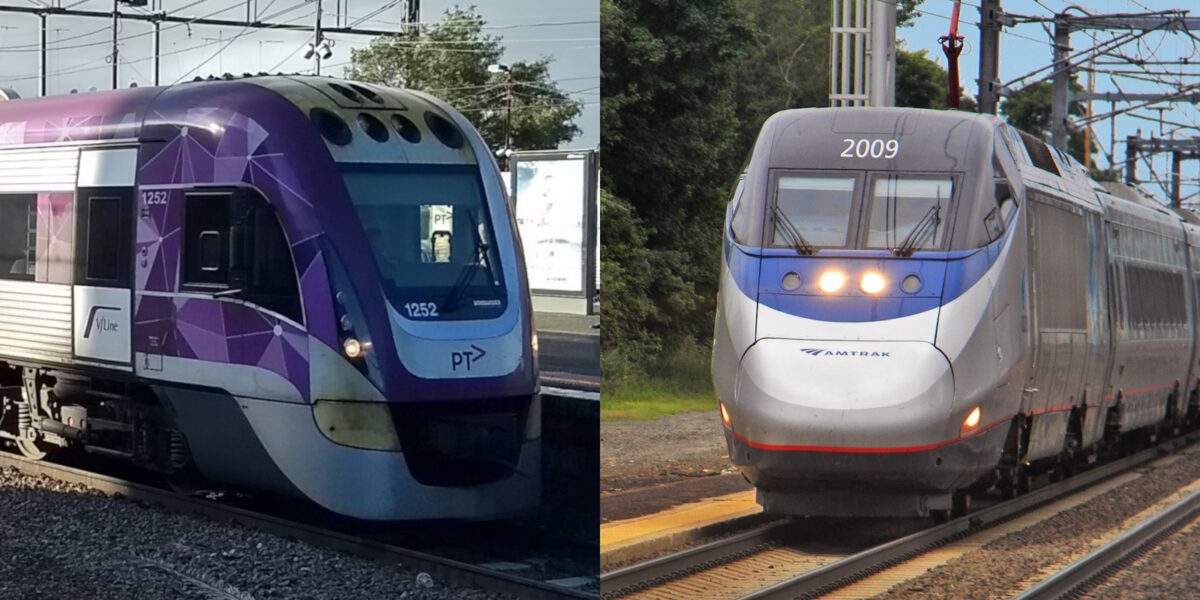
Somewhere I saw some ridership stats for Amtrak, and I noticed with some interest that they’re not that much higher than V/Line, and lower than NSW Trainlink.
So I decided to make a chart.
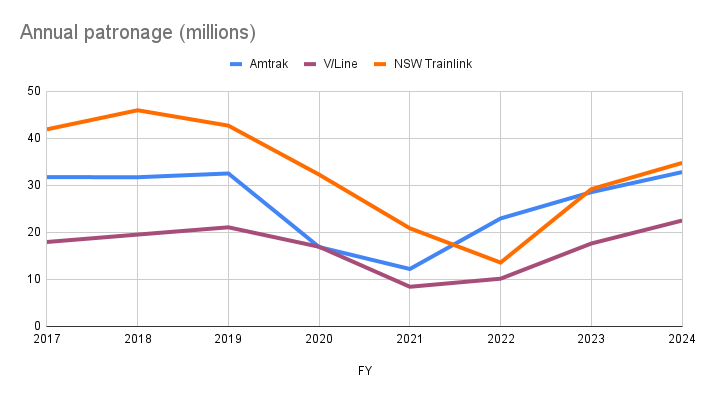
(Source: BITRE Trainline 12; Amtrak annual reports)
The reporting periods are slightly different: Amtrak’s annual figures are for year ending September; V/Line and NSW Trainlink are year ending June. This is why in 2020, V/Line’s numbers (16.9m) were slightly higher than Amtrak’s (16.8m), which were move affected by COVID-19 for that financial year.
Reporting differences aside, I was surprised that the two busiest Australian state rail operators are in the same ballpark as the USA’s national operator – and that in most years, NSW Trainlink is consistently higher.
Other Australian states don’t even get close.
- Queensland (614,000 in 2023-24) and Western Australia (161,300) even added together are less than a million passengers per year.
- Tas doesn’t have passenger rail.
- SA/Vic share Journey Beyond’s The Overland, and there’s some data thanks to the government subsidies; it was 23,500 in 2022-23. (Have I missed anything?)
- Otherwise, SA and NT only have JB’s tourist trains (such as The Ghan and the Indian Pacific), but JB is privately owned, and does not seem to publish any data.
- Have I missed anything?
Many of Amtrak’s journeys are longer than those on V/Line and NSW Trainlink. Amtrak has numerous routes of over 2000km – far longer than anything in Victoria or NSW.
Amtrak also runs shorter distance services, especially in the Northeast Corridor. But if I divide Amtrak’s passenger miles by total ridership and it comes out at an average of 199 miles, or 320 km – a long journey by Australian rail standards. This is not much less than V/Line’s longest line, Swan Hill, 345 km.
V/Line of course serves some very short suburban trips, in Melbourne’s west and north, which account for a lot of its patronage.
So is it an apples for apples comparison? Perhaps not, but I thought it was interesting. Perhaps it’s a reminder that while Australia may lag on public transport in some ways, particularly in comparison to Europe and Asia, we’re still mostly ahead of the USA.
- Pic above: V/Line VLocity train at Caulfield / Amtrak Acela train at Old Saybrook, by Shreder 9100 via Wikipedia CC BY SA 3.0


11 replies on “Australia vs Amtrak”
How much of each is commuter services for daily commuters and how much is long distance for irregular travellers? Amtrack is primarily a long distance service but does does run some commuter lines under comtract in three states. In NSW, about 2/3 of that figure (20 million) is interuran commuter services – which are I believe now administered by Sydney Trains. Victoria?
An interesting comparison.
At the opposite end of the spectrum, and perhaps only semi-related, Puffing Billy Railway’s 2023/24 Annual Report indicates that their 398,523 passengers were more than both WA & Journey Beyond.
Amtrak is probably the “logical” choice for many people, on the routes on which it operates, for trips of up to 350 km (such as New York to Boston). For distances longer than that, it’s a niche choice – much the same as in Australia. High speed rail changes the equation, of course. But Amtrak operates under constraints. Freight traffic (and there’s a lot of that in the US) seems often to have priority, and its Acela equipment is in places subject to track speed restrictions.
Would be interesting to see North American agencies more similar in scope to V/Line and NSW TransLink included (in addition to Amtrak). Could include GO, EXO, NJT/Metro North/LIRR, MBTA, SEPTA, VRE/MARC, Metra, CalTrain, MetroLink, etc.
I’m surprised at how low Queensland is. Is this just the really long-distance stuff, with regional services in SE Qld (to places like the Gold and Sunshine Coasts) included under Brisbane data?
@TonyP, the latest Amtrak annual report says that of the 32.8m total ridership, 4.3m of that was long distance. 14.5m was “State supported” and 14.0m was NE Corridor.
@DB, thanks for that – comparing to some of those agencies would make a lot of sense, though finding the equivalent services run by a big multi-purpose agency like SEPTA could be complicated.
@Ben, yes I think the BITRE numbers are really by operator rather than region. So the Gold/Sunshine Coasts are in with the urban rail data. In contrast the NSW Trainlink data includes Newcastle.
@Daniel. Interurban commuter services in NSW are between Sydney and Newcastle, Dungog, Scone, Bathurst, Goulburn and Nowra.
I think that APTA’s quarterly ridership data breaks out the numbers by mode (eg bus, light rail, heavy rail/metro, commuter rail, etc) for agencies like SEPTA that runs multiple types of service.
https://www.apta.com/research-technical-resources/transit-statistics/ridership-report/
I prefer Amtrak over Vline. The trains are much nicer than the vline ones
I travelled on Amtrak and Via Rail Canada last week from New York to Toronto, and Toronto to Montreal. Overall service was poor on both carriers. The infrastructure is inferior to what one finds in the UK, Europe or Australia – they don’t really have platforms, so you have to haul yourself and your luggage up from ground level onto the train, and the platforms are pretty dingy with cramped layouts (some of the station concourses are very nice, though). On board catering is comparable to what you’d find in the UK and Europe. Staff, particularly in Canada, are unhelpful, officious and rude – not good ambassadors for their country.
Passenger numbers aren’t a good point of comparison. If you throw in not just passenger km, but numbers of rollingstock and employees, Amtrak is much larger than either V-Line or NSW Trainlink.
This is probably not an apples to apples comparison. In the 1980s when the average trip distance was longer, the average NSW passenger went 193 km while in Victoria it was 124 km, with the increased prevalence of commuter operations for regional railways and cuts to long distance rail in both states I suspect the average distance would have fallen by 30-50%. Amtrak’s average passenger distance is nearly 400 km. Its long distance passengers go around 900 km, depending on the exact year, last year it was 550 miles, the year before it was 565 miles, so despite their smaller numbers they count for more volume of transportation than the short distance state supported routes which carried 5x the passenger numbers (aka ticket sales).
Amtrak operates over 2100 carriages, V-Line maybe has 450?, NSW Trainlink plus intercity services have 750 carriages once D sets and R sets replace everything.
Amtrak has over 20,000 employees, V Line has 2200 staff and NSW trainlink had maybe 3,000?
Amtrak’s network is over 21,400 miles or nearly 35,000km – which is longer than the entire Australian railway network.
So Amtrak is just much larger on everything except raw numbers of passengers (which aren’t a good measure, since a passenger going 1km is counted the same as one going 100 km or 1000 km).