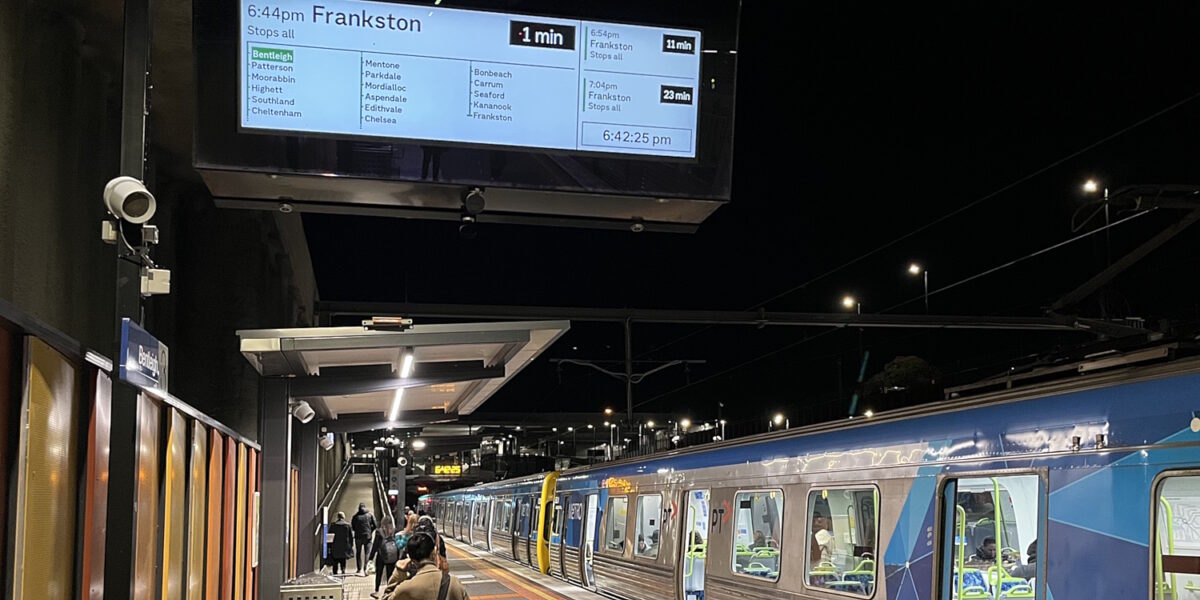
Something that’s become particularly noticeable around the Metro network is long dwell times at suburban stations, particularly in peak hour.
Here’s a quick sample from three stations: Caulfield, Windsor and Bentleigh.
Can you guess which train will depart first, and how long it’ll take?
While it only took about 15 seconds for passengers to board and alight each train, but the total time spent at the platform (for those of you without the patience to watch it all; I don’t blame you) was about:
- 50 seconds at Caulfield
- 80 seconds at Bentleigh
- 90 seconds at Windsor.
Why does this happen? Because the timetable has recovery time built in it, so that the service can easily recover from delays.
Comparing the outbound PM peak timings for these lines over the years, one can see a pattern.
| Year | Richmond to Dandenong (exp Sth Yarra-Caulfield) | Flinders St to Sandringham (all stops) | Richmond to Frankston (all stops) |
|---|---|---|---|
| 1974 | 43 | 30 | 64 |
| 1980 | 41 | 31 | 64 |
| 1990 | 40 | 30 | 60 |
| 1997 | 37 | 28 | 59 |
| 2006 | 38 | 28 | 59 |
| 2011 | 37 | 29 | 63 |
| 2018 | 39 | 30 | 65 |
| 2025 | 41 | 31 | 65 |
There were speed gains in the late-1990s, but just in the last few years, timings have been increased to as long (or longer in some cases) as they were in the 1970s, back when the network was running old slower heavy wooden trains built in the 1910s.
In one example, in evening peak, Prahran to Windsor, a distance of just 800 metres, is now allowed 3 minutes. This is why the train shown above at Windsor was sitting doing nothing for well over a minute.
Train drivers know it’s an issue. One I chatted to said long waits at stations are now commonplace.
Put simply, good punctuality has come at the expense of journey times.

A couple of things spring to mind to help with this issue.
- Tighten up the timetables. We don’t want unrealistically fast timetables that can’t be achieved, but nor should we be wasting everybody’s time. The balance isn’t quite right at present.
- Use the 246 bus’s method of Rapid Running. Where possible, and at times of high frequency, allow the train to run as fast as possible along the line – and adjust the performance regime to allow that.
It’s not always possible of course. Track capacity further down the line can be an issue.
And loading/alighting times will vary day to day. Patronage is generally heavier midweek than on Mondays and Fridays.
One of Metro’s internal slogans is “Every second counts“. That should count not just for them, but also for their passengers.
Routinely having multimillion dollar trains and their driver and all their passengers waiting long periods at stations, making the trip slower than it needs to be… that’s a bad outcome.

14 replies on “Excessive dwell times”
Sandringham line is in a different category to the others. The time increase in the 90s was the result of a timetable change that was based around a speed limit increase that never happened. The timetable instantly became unreliable until actual running times were finally restored last decade.
Also worth noting that train times are designed for the Comeng fleet. Newer trains that accelerate and brake quicker will naturally end up with a little more dwell.
Also, increased dwells are not always a result of padding, but sometimes poorly distributed running times from station to station. The timetable should be designed for dwells at junctions or significant stations, but often has them at random locations. So a train that may sit for a minute somewhere less significant may end up behind schedule at the next junction or major station.
I thought that one of the Government’s promises was that level crossing removals were going to make trains run faster? No pesky speed limits across the roads, they said.
But most of the LCRs are at stations, so the trains are going slowly anyway, I replied…
I caught a train from Kooyong Station to Flinders Street last week and the train I was to catch was delayed by a track trespasser near Glen Iris Station. I had a feeling the train was travelling a bit faster towards the city after it arrived, but the track is quite curving for most of the distance, so trains must be quite heavily speed restricted. However, once the train left Richmond Station, I’ve never had such a fast trip from Richmond to Flinders Street, so clearly there is some fat there.
Ideally Frankston through running trains shouldn’t need recovery time at Flinders Street, but maybe it is not a bad thing.
Well, never mind trains. Take a look at the 604 bus! 72 tram time between Anzac Station and Chapel Street, daytime weekday, 11 minutes with 9 stops. 604 bus between Anzac Station and Chapel Street, 17 minutes, with 5 stops. Bus drivers have to kill a lot of time, and even after Chapel Street, expect another wait in Orrong Road. The PTV app today a live time bus at Chapel Street in 7 minutes. Its scheduled time was in 13 minutes. Looking at 2006 timetable for the 219 bus, the time from Elsternwick Station to Domain Road was 25-28 minutes, now a ridiculous 44 minutes.
The exact same comments can be made about deliberately longer running times for trams, by placing the tram stop on the far side of the intersection with zero tram priority. So the tram stops for the red (zero passengers on or off) light goes green tram crosses the intersection the stops again for passengers on and off. Each of this failed design forces trams to stop twice. Do this 10 times along the route and add 5 minutes to the running time.
Is time for disability access (likelihood of the need to place and remove a ramp at the first door) a consideration (if not for the three example stations, then for other stations around the suburban network)?
Whilst not the topic of your post, the video goes some way to showing problems caused by the anti-passenger “burn lines” used by MTM – particularly in the case of the Windsor video.
Is there anywhere else in the world where the destination of the train is deliberately hidden from passengers? Only in Victoria would an “initiative” this be allowed to become permanent
@Flanders, thanks for the background.
Maybe the Sandringham timetable needs adjustment so that extra minute is further down the line. It doesn’t make sense at Windsor.
(I assume they also don’t want this kind of waiting at a station that’s immediately before a level crossing, such as the three Brighton stations and Hampton.)
@Bruce, no question trams are delayed, but that’s of no advantage to the tram operator’s punctuality stats.
@Kev, it’s not unreasonable to allow some time for ramp access, so it doesn’t cause snowballing delays, but they shouldn’t assume every stations or every service needs that.
It seems this is one of the challenges of running a timetabled service. Presuming the constraint that a train can never run early, timing can’t be based on average travel times. There is no possibility of fast running segments offsetting slow running ones. Added to this is the tendency for a slow running service to get slower, as it picks up more passengers than normal (the bunching up effect). So you’re left timetabling to the typical slowest time.
A turn up and go metro service, on the other hand, will be aiming to push through as quickly as possible.
This happens every single time at Box Hill and Chatham (depending on direction), the train ends up 1-3 minutes ahead of schedule as it runs express through a nonexistent station according to the completely unchanged timetable which still expects the train to stop at Surrey Hills and Mont Albert, as opposed to just Union. Never mind this section of track being on one of the slowest lines on the network, with a speed limit of 65 km/h (up/down local, as the centre track is apparently still 80 even though it’s in the worst condition of the three by far). Often, drivers just cruise between those stations at 40 or 50 just so the train doesn’t have to wait as long.
246 “rapid running”, as in every 30 minutes after 8PM and being timed to depart before the city SmartBuses arrive (and the 302 as well) so you always have to wait. Could rapid running at least ignore timetables until 10PM instead of assuming the entirety of Victoria is a ghost town when the sun sets? Rapid running on SmartBus routes should have happened a over decade ago, they’re always late.
Another example of an instance where some smart changes could improve service for travellers, without a cost impost on the operator.
Travelling to the Grand Final Parade on the Belgrave/Lilydale line on Friday, my son actually queried why we were spending so much time at each station.
If the next train/bus is not timetabled for more than 10 minutes, then dwelling is ok, otherwise, keep the train and bus running, as fast as possible, knowing another service will be along shortly.
SA government scrambling to be re-elected and thought it worthy of using the premier to announce a 2 min saving on the Gawler Line – https://www.facebook.com/share/v/1AsucM4kcn/
They use this “rapid running” a lot in Brazil, the buses fly along like the clappers. At various points along the route the bus will stop at a countdown interval timer to evenly space out the services, the driver leans out the window to push a button to reset it, and flys off again, very low-tec but works well and no timetables, just turn a up and go service.
The 246 could do with even more frequent buses and running later into the night too.
Here’s an idea: run trains at 10-minute frequencies throughout the day with a guaranteed 8-12 minute waiting window. Drivers go as fast as they safely can, timetables are abolished, and passengers aren’t forced to watch grass grow waiting for services:
Werribee express trains that are running late between Newport-Footscray-North Melbourne are purposely timetabled so they run right behind a stopping all stations Williamstown or Laverton train. This is smart because if it’s running 2 or 3 miniutes late it’s able to run at the higher express speed further than timetabled, making up time.