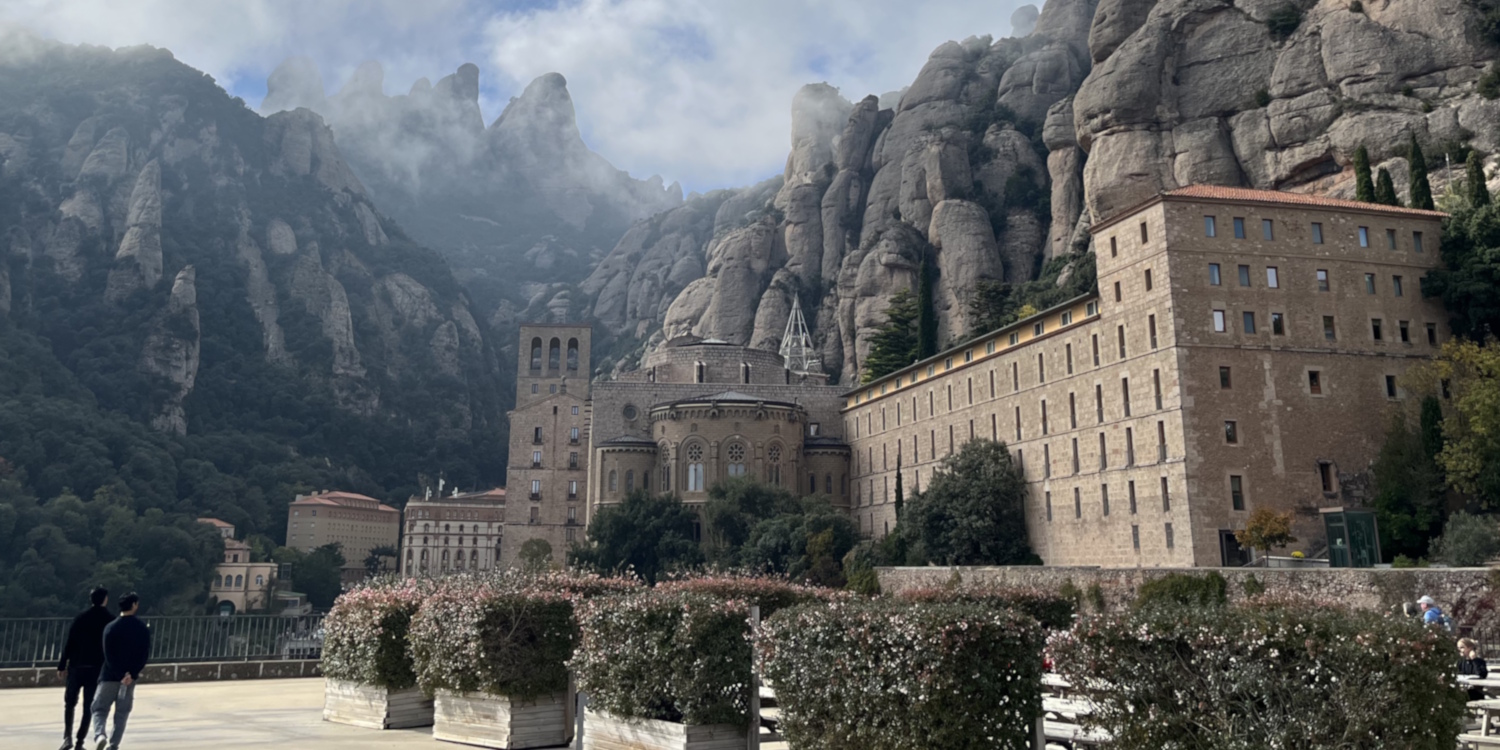
For today we planned to visit Montserrat (“serrated mountain”), a mountain and historic town about 90 minutes outside Barcelona.
Organising this was a bit confusing.
The visitor info says to get there you catch an R5 train to Monistrol de Montserrat station (Carrer del Pont), then use the rack railway to reach the town. (Another alternative is a cable car from a different connecting station.)
You can book online for the rack railway and some of the town sights, but as far as I could see, not for the R5 train.
What’s not obvious to a tourist is that the R5 service isn’t run by Renfe, the Spanish national railway – it’s run by FGC, the Catalonian state railway. So you won’t find R5 on Renfe maps, and their ticket machines can’t sell you a ticket.
They will sell you a ticket to Castellbell I El Vilar-Monistrol de Montserrat, which is a completely different station. Even Google Maps seems confused about this, abbreviating both to the same name, even though they’re 4km apart.

Thankfully a helpful Renfe employee in a ticket office was able to direct us to Plaça Espanya station, where we could buy tickets and board the right train. And helpfully there was specific Montserrat signage at that station, though it was lucky I also figured out to follow the directions to the squiggle representing FGC.

Once we were on the train it was smooth sailing. The line runs out of central Barcelona, through the burbs and then into regional areas, steadily climbing. There’s some great scenery (and for rail geeks, the line is all electrified).
I was wrestling with my phone, trying to get Google Maps to simply stay on the display of where we were on the train. No, it has the common modern app problem: it loves to continually reset itself to a default view when you don’t want it to.
Anyway, on arriving at the correct station, you walk along the platform to board the rack railway. Both services run once an hour at most times, and the timetables are co-ordinated in both directions… and the R5 trains are routed onto the platform adjacent the rack railway to make the connection easier.


The rack railway runs for about 5km, and climbs some 550 metres during the journey. As we climbed, the fog set in, making for some amazing (non) views of the mountains. At least we knew we were high up!
Arriving at Montserrat, there was still plenty of fog, but it was starting to lift and it ended up being a very pleasant da
It’s very hilly, but the town is quite walkable. Initially we headed into the museum, which had a mix of great paintings, and a modern audio/visual display with exhibits showing the history of the town.


Coming out of the museum, we had some lunch in the nearby cafeteria, then strolled along the main street to see some other sights.
The fog was mostly gone by now, and there was a great view up the mountain towards the top, with the funicular carriages making their way up and down.

We had a timed booking for the monastery, in particular the Black Madonna – you queue for a while, and each stage of the queue takes you up some more stairs. Then at the front of the queue, one by one people go up the stairs and through the little room with the statue.
By the point, unsurprisingly, you’re very focussed on what you’ve come to see. What none of us noticed was that behind us was a window out into the chapel. I only noticed it later when we were down there, and you can see the room at the very top and front, with the people going through admiring the statue.


From there we headed to the funicular. There are actually two – one heading down, one heading up. But the down one was out of service for refurbishment works, so up it was.
It runs every 12 minutes, so not long to wait, and even in late October there were enough of us tourists around for it to be pretty busy.
The funicular works with the two carriages acting as counterweights to each other. The line is single, with a passing loop in the middle. It’s not quite as steep as it looks from a distance, but it is pretty steep. (See video below)
At the top station there are various walking paths, and we set off along one of them to see what we could find. It’s pretty steep but there are some amazing views.
Eventually we reached a tiny chapel, the Ermita de Sant Onofre.


From there, there are some harder-to-navigate paths built into the mountainside – with various warning signs. It got tougher to continue, and eventually we turned back.
Good exercise though.

Back at the station there’s a viewing deck, which we looked at before catching the funicular back down again.
One passenger (I’ll let you guess the nationality, but he was living up to a stereotype) was talking on the phone (in English) about his various medical conditions loud enough for everyone to hear. Mate. Inside voice.
After a look through the tourist/gift shop, we got back onto the rack railway to head down the mountain, then made the connecting train back to Barcelona.
This was pretty busy, with quite a few people standing for some of the trip. We arrived back in Barcelona around the time of what would be rush hour at home, and presumably is here too, though the metro back wasn’t too too packed.
We got back to the flat, and after wrestling with the washing machine to do some laundry, headed out again for yet more tapas! Nom nom nom.

Tomorrow’s plan: more Gaudi, and the Gothic Quarter.

3 replies on “Climbing the serrated mountain”
Interesting; when I went there, about 15 years ago, the end of my journey was completely different. It was via a danglebahn from a completely different station (the next one along the line). (Google maps says this still exists – I had to check!)
The journey was organised by some people that I’d met at the conference, I just tagged along. Now I wonder, did they not know about the rack railway or did it not exist?
yep the cable car departs from one stop along the R5 line.
The rack railway has been around for a long time. Next to the line at an intermediate stop they have an old steam engine and carriage that used to run on the line. But maybe when you were there the line was out of service – it’s definitely been modernised over the years.
What a spectacular view. Wonderful. And the funicular looks almost vertical from your photos.
Your various travel blogs seem to confirm that the best way to travel is to use PT (or walk) in large cities but hire a car when you are staying anywhere else. You get so see a lot more (e.g. explore national parks) more quickly and less hassle.